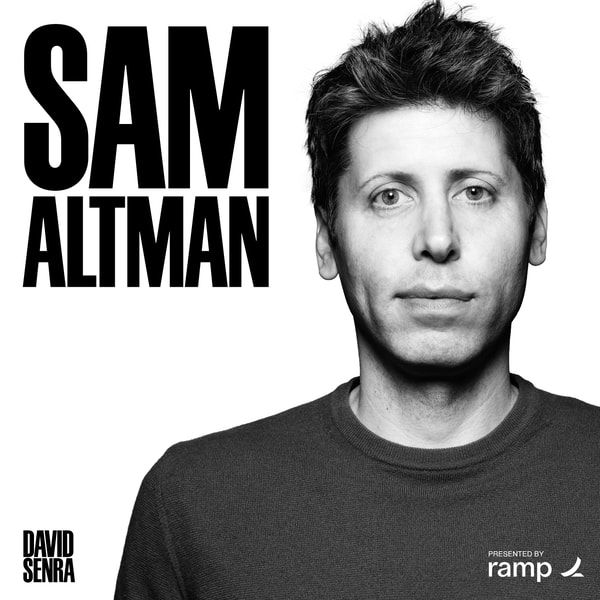
Sam Altman on Building OpenAI & Betting on the Impossible
David Senra
18 HOURS AGO
Sam Altman on Building OpenAI & Betting on the Impossible
David Senra
18 HOURS AGO
Shownote
Shownote
Sam Altman has spent his career at the intersection of startups, investing and
artificial intelligence. He says he was fascinated by AI as a child in St.
Louis, studied it in college and eventually helped start OpenAI
[https://openai.com/] in 2015 after concluding that the most important
opportunities often begin as non-consensus bets. His experience investing in
startups taught him to look for power laws, back unconventional talent and
recognize the decisions that can change a company’s trajectory.
At OpenAI, Altman says most of his effort goes toward research and compute.
Scaling compute requires coordinating chips, fabrication plants, data centers,
power systems, finance, policy, supply chains and logistics—what he describes as
potentially the most expensive infrastructure project in history. He argues
OpenAI should function primarily as a platform: one direct interface to powerful
AI and one application programming interface that lets people build on top of
it. That strategy requires killing good ideas to preserve resources for the
great ones.
Altman expects AI capabilities to advance faster than society and the economy
can absorb them. Human habits and institutional inertia will slow the
transition, which he believes may make it smoother. He also expects human
connection to become more valuable and AI to enable a major increase in
small-business formation. His central concern is that AI should expand human
agency rather than concentrate power in a small number of companies, people or
models.
He also explains how Y Combinator [https://www.ycombinator.com/] shaped OpenAI’s
operating philosophy: make non-consensus bets, put technical people in charge,
ship early, learn from reality and iterate. Yet OpenAI required breaking the
classic startup playbook. The organization spent four and a half years without
launching a product and had to invent ways to measure research progress without
customer feedback. On its first day, roughly a dozen people gathered in Greg
Brockman [https://gregbrockman.com/]’s apartment and quickly realized they did
not know what to do next. Years of what Altman calls “chaotic stumbling”
eventually produced the research path that led to GPT.
Show notes: https://www.davidsenra.com/episode/sam-altman
[https://www.davidsenra.com/episode/sam-altman]
Made possible by
Ramp: https://ramp.com [https://ramp.com]
AppLovin: https://applovin.com/senra [https://applovin.com/senra]
Deel: https://deel.com/senra [https://deel.com/senra]
Chapters
(00:00:00) Tobi Lütke, AI-Native Companies & Why Adoption Moves Slowly
(00:05:45) Sam's Own Resistance to AI & the Missing iPhone Moment
(00:10:00) Models, Compute, Power Laws & Non-Consensus Talent
(00:18:37) From AI-Obsessed Kid to Founder, Investor & Back Again
(00:23:19) Impossible Problems, Scientific Discovery & Human Connection
(00:30:16) AI's Two Biggest Risks: Loss of Control & Centralized Power
(00:33:09) Iterative Deployment, AI Safety & Learning From Reality
(00:40:27) Why People Fear AI & the Coming Small-Business Boom
(00:46:13) Context, Memory & the Next Way We Will Work With AI
(00:49:17) OpenAI's Platform Strategy & Killing Good Ideas
(00:53:20) Peter Thiel, Paul Graham & the Value of Nonlinear Thinkers
(01:00:42) How Y Combinator Changed Startups & Shaped OpenAI
(01:04:03) Learning More From Success & the Power of Repetition
(01:09:45) Building OpenAI Without Customers, a Product or a Playbook
(01:15:57) Letters to His Son & Preserving the Story
Learn more about your ad choices. Visit megaphone.fm/adchoices
[https://megaphone.fm/adchoices]
Highlights
Highlights
This conversation examines why adapting to AI is as much a human and organizational challenge as a technical one. It connects changing work habits with the decisions, risks, and experiments involved in building transformative technology.
Chapters
Chapters
Tobi Lütke, AI-Native Companies & Why Adoption Moves Slowly
00:00Sam's Own Resistance to AI & the Missing iPhone Moment
05:45Models, Compute, Power Laws & Non-Consensus Talent
10:00From AI-Obsessed Kid to Founder, Investor & Back Again
18:37Impossible Problems, Scientific Discovery & Human Connection
23:19AI's Two Biggest Risks: Loss of Control & Centralized Power
30:16Iterative Deployment, AI Safety & Learning From Reality
33:09Why People Fear AI & the Coming Small-Business Boom
40:27Context, Memory & the Next Way We Will Work With AI
46:13OpenAI's Platform Strategy & Killing Good Ideas
49:17Peter Thiel, Paul Graham & the Value of Nonlinear Thinkers
53:20How Y Combinator Changed Startups & Shaped OpenAI
1:00:42Learning More From Success & the Power of Repetition
1:04:03Building OpenAI Without Customers, a Product or a Playbook
1:09:45Letters to His Son & Preserving the Story
1:15:57Transcript
Transcript
David Senra: I just brought up Tobi Lütke and the fact that I recorded with him previously. Why did you say that you think he's one of the most interesting CEOs right now?
Sam Altman: One of the things that struck me the most about Tobi is. In the very ea...
