
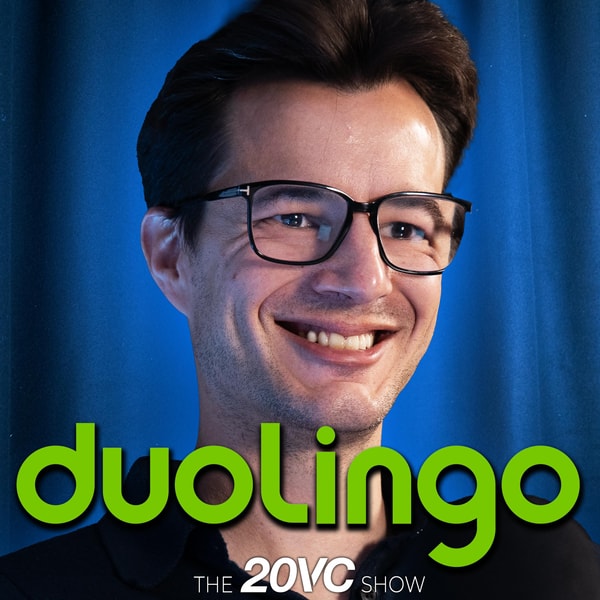
20VC: Duolingo Co-Founder on Why $3M is Harder than $100M to Raise | Why You Should Always Take Tier 1 VCs Even at Worse Terms | Why Europe Can't Win Unless the US Screws Up | How AI Impacts the Future of Work and Education with Severin Hacker
20VC: Duolingo Co-Founder on Why $3M is Harder than $100M to Raise | Why You Should Always Take Tier 1 VCs Even at Worse Terms | Why Europe Can't Win Unless the US Screws Up | How AI Impacts the Future of Work and Education with Severin Hacker
20VC: Duolingo Co-Founder on Why $3M is Harder than $100M to Raise | Why You Should Always Take Tier 1 VCs Even at Worse Terms | Why Europe Can't Win Unless the US Screws Up | How AI Impacts the Future of Work and Education with Severin Hacker
Severin Hacker, Co-Founder and CTO of Duolingo, discusses the challenges and successes of building one of the world's leading educational apps. The conversation delves into the pivotal role of AI in transforming education, fundraising strategies, and the unique dynamics of operating a global tech company from outside Silicon Valley.
Hacker highlights the difficulties of raising smaller funds compared to larger sums, emphasizing the importance of choosing the right market for fundraising. Duolingo's transition to an AI-first approach has revolutionized content creation, reducing time from years to months. Internally, AI enhances productivity but still struggles with complex tasks. Despite advancements, Hacker believes a CS degree remains valuable in the short term. The discussion addresses societal impacts of AI, including potential shifts towards hobby-centric lifestyles. Duolingo continues to hire entry-level engineers and integrates AI into customer support while maintaining user engagement through gamification. Hacker reflects on Duolingo's biggest mistake—delaying certain initiatives—and underscores the significance of founder involvement in product design. He advises European founders to relocate to the US for better opportunities, citing differences in startup ecosystems. The conversation also touches on the pros and cons of going public, balancing predictability in financial markets with current technological unpredictability. Finally, Hacker shares insights on wealth, happiness, and the importance of purpose-driven entrepreneurship.
00:00
00:00
Raising $3M can be harder than raising $100M.
02:13
02:13
The host shares excitement about having Severin as a guest.
04:43
04:43
Duolingo was an OpenAI launch-partner for GPT-4 and saw its potential for their mission.
07:01
07:01
AI boosts content creation by 12x at Duolingo.
11:41
11:41
AI is good at taking a simple app from 0 to 80% and isolated transformations in single files but struggles with large code bases.
13:36
13:36
AI makes software production cheaper, encouraging more people to create apps.
16:01
16:01
Tech people and investors fear losing purpose due to AI advancements.
22:55
22:55
The hardest part of language learning is motivation.
25:21
25:21
Product quality lies in details, not rushing to get things done.
38:37
38:37
Duolingo extends streaks during power outages to support user consistency.
44:32
44:32
Flat organizations aren't sustainable at scale; hierarchy is necessary.
45:00
45:00
They've delegated most day-to-day engineering and now focus 80% of their time on AI's impact on Duolingo.
49:04
49:04
Not fearing companies with low retention but wary of those with higher retention than Duolingo.
55:55
55:55
US attracting global talent benefits Silicon Valley, but harder immigration could help Europe.
58:32
58:32
Investors didn't push for early monetization, which was counterintuitive but the right decision.
59:15
59:15
Duolingo waited too long to hire senior managers and faced fundraising difficulties.
1:01:02
1:01:02
Union Square Ventures was the only firm to invest without demanding a move to Silicon Valley.
1:03:02
1:03:02
The best founders may not need investor value, but investors should still support them.
1:07:27
1:07:27
European companies should consider going public in the US.
1:09:00
1:09:00
Private companies may stay private, while mature ones like Stripe should go public for employee liquidity.
1:10:24
1:10:24
European companies need to go public to make employees wealthy.
1:14:26
1:14:26
AI productivity gains can solve demographic and economic issues.
