
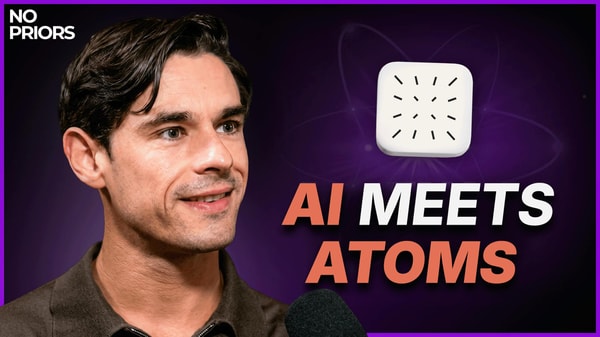
AI for Atoms: How Periodic Labs is Revolutionizing Materials Engineering with Co-Founder Liam Fedus
AI for Atoms: How Periodic Labs is Revolutionizing Materials Engineering with Co-Founder Liam Fedus
AI for Atoms: How Periodic Labs is Revolutionizing Materials Engineering with Co-Founder Liam Fedus
Liam Fedus, co-creator of ChatGPT and former VP of post-training at OpenAI, discusses his new venture Periodic Labs, which applies AI scaling laws to materials science and chemistry. The conversation explores how large language models can be connected to the physical world to accelerate scientific discovery and overcome data bottlenecks in material science.
Fedus explains that while ChatGPT was initially too weak for materials science, recent advances in models, reasoning, and agents have made it possible to apply AI to physical experiments. Periodic Labs uses language models as an orchestration layer to direct experiments and coordinate specialized neural networks for atomic systems, creating an integrated closed-loop system that combines literature, experimental data, and multiple modalities. The company aims to provide an intelligence layer for companies facing materials and process engineering bottlenecks, with a business model comparable to biotech. Fedus envisions accelerating physical world development through AI-driven atomic rearrangement synthesis, potentially matching digital progress in productivity for semiconductors, energy, and aerospace. He highlights the multidisciplinary collaboration between physicists, chemists, AI researchers, and engineers as key to overcoming data bottlenecks through larger-scale experiments and automation. Regarding AGI, Fedus notes that intelligence is not scalar and that software engineering self-improvement is happening now due to verifiability, while AI research progresses more slowly due to longer experiments.
00:05
00:05
An AI foundation lab for atoms
00:39
00:39
Physics provides a principled approach to problem-solving.
05:14
05:14
Connecting AI to the physical world is essential
09:29
09:29
It is an active loop, not a static data pool.
09:52
09:52
Generalization works for quantum systems but not fluid dynamics
11:31
11:31
Language models orchestrate experiments and coordinate specialized neural nets.
15:29
15:29
AI education reaches every young girl
16:10
16:10
AI-driven atomic rearrangement synthesis could match digital progress.
17:45
17:45
Multidisciplinary collaboration drives scientific progress
19:41
19:41
Compute costs dominate over physical infrastructure
21:12
21:12
Periodic Labs is hiring for AI and physical science roles
21:44
21:44
Intelligence is not a scalar.
23:30
23:30
Software engineering self-improvement is happening now
27:59
27:59
Reliable general robotic systems are needed to scale high-throughput experiments.
27:59
27:59
AI interfacing with the physical world is a massive opportunity
