
Why did Comcast ever buy NBC?
Decoder with Nilay Patel
Jul 09
Why did Comcast ever buy NBC?
Why did Comcast ever buy NBC?
Decoder with Nilay Patel
Jul 09
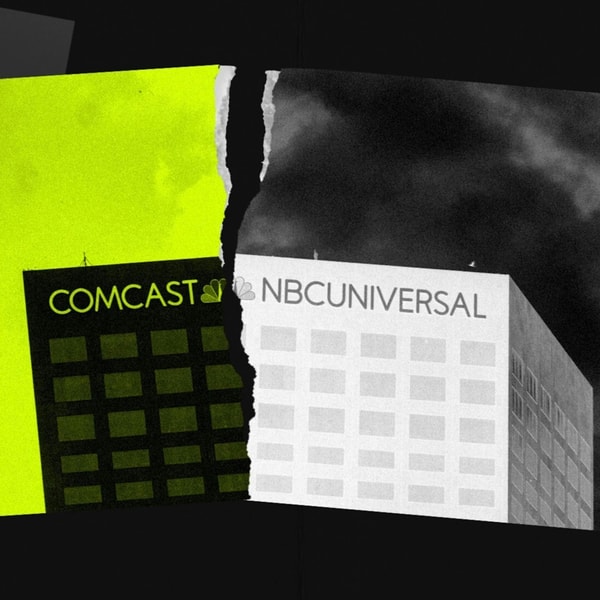
In this episode, the host and Peter Kafka, a media industry correspondent, dissect Comcast's recent announcement to split into two separate companies: a broadband business and NBCUniversal. They explore the end of a 15-year experiment that aimed to combine content creation with distribution, a strategy that has repeatedly failed across the media landscape. The conversation delves into the history of this 'content plus pipes' model, the rise of Netflix, and the shifting dynamics of the internet and cable industries.
The discussion centers on Comcast's decision to unwind its merger with NBCUniversal, marking the failure of the 'content plus pipes' strategy. Unlike AT&T, which quickly sold WarnerMedia, Comcast held onto NBCUniversal for 15 years, largely due to the Roberts family's control. The split is seen as an inevitable unbundling, driven by the success of Netflix and the decline of traditional pay TV. Comcast now faces new competition in broadband from fixed wireless providers like T-Mobile and Verizon, leading to flat subscriber growth. The conversation highlights how the dream of vertical integration—owning both content and distribution—has been undermined by the rise of internet platforms and creators, making it impossible for ISPs to extort content providers. The future for standalone NBCUniversal is uncertain, as it must compete with free platforms like TikTok and manage rising sports rights costs, while the core media business struggles against low-cost competitors.
07:46
07:46
The merger never worked.
10:37
10:37
Only Comcast benefited from running a media company
32:42
32:42
ISPs tried to replicate the cable TV model by owning content and pipes.
40:27
40:27
Proprietary content rarely drives enough demand for a specific distribution platform.
58:42
58:42
Content plus pipes strategy has failed.
