
Decoding the Mysteries of Quantum Mechanics
The Quanta Podcast
Feb 24
Decoding the Mysteries of Quantum Mechanics
Decoding the Mysteries of Quantum Mechanics
The Quanta Podcast
Feb 24
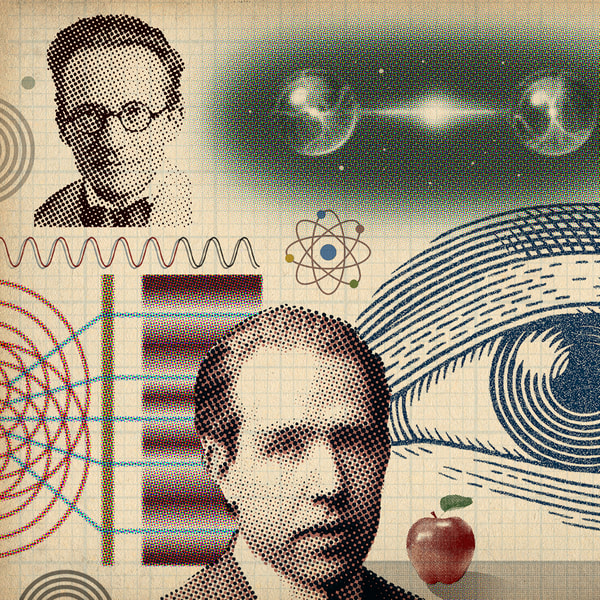
A century after quantum mechanics upended our understanding of reality, physicists are revisiting its deepest puzzles—not with new equations, but with fresh insights into how the quantum world gives rise to the stable, shared reality we experience every day.
This episode traces how modern quantum foundations have moved beyond the century-old 'measurement problem' by reframing it through decoherence and quantum Darwinism. Rather than invoking mysterious wavefunction collapse or conscious observers, physicists now understand that interaction with the environment rapidly suppresses quantum superpositions—making macroscopic objects appear classical. Decoherence explains *why* interference vanishes, while quantum Darwinism reveals *how* objective facts emerge: only certain robust properties (like position) are redundantly imprinted across the environment, allowing multiple observers to independently access and agree upon the same outcome. This natural selection of 'pointer states' bridges the quantum-classical divide without adding new physics. Though interpretations like Copenhagen and Many-Worlds still differ philosophically, their empirical tensions soften when viewed through this lens—suggesting that reality isn’t imposed by observation, but stabilized by ubiquitous environmental entanglement. The result is not a single answer to 'What is reality?', but a compelling mechanism for how shared, classical experience arises from quantum underpinnings.
03:33
03:33
At the subatomic scale, particles can act as both particles and waves
09:51
09:51
Decoherence causes quantum superpositions to vanish through environmental entanglement, not wave function collapse
16:06
16:06
Only certain properties like position leave observable imprints in the environment, enabling objective classical reality
19:21
19:21
In quantum Darwinism, all imprints in the environment must be the same, meaning all observers will agree on the outcome
26:34
26:34
Quantum Darwinism explains how classical reality emerges through environmental selection of quantum states