From IDEs to AI Agents with Steve Yegge
The Pragmatic Engineer
Mar 11
From IDEs to AI Agents with Steve Yegge
From IDEs to AI Agents with Steve Yegge
The Pragmatic Engineer
Mar 11
Unprocessed episode, you can be the first!
Shownote
Shownote
Brought to You By:
• Statsig [http://statsig.com/pragmatic] — The unified platform for flags,
analytics, experiments, and more.
• Sonar
[https://www.sonarsource.com/pragmatic/?utm_medium=paid&utm_source=pragmaticengineer&utm_campaign=ss-ai&utm_content=podcast-sonar-ai-lp&utm_term=ww-all-x&s_category=Paid&s_source=Paid%20Other&s_origin=pragmaticengineer]
– The makers of SonarQube, the industry standard for automated code review
• WorkOS [https://workos.com/] – Everything you need to make your app enterprise
ready.
—
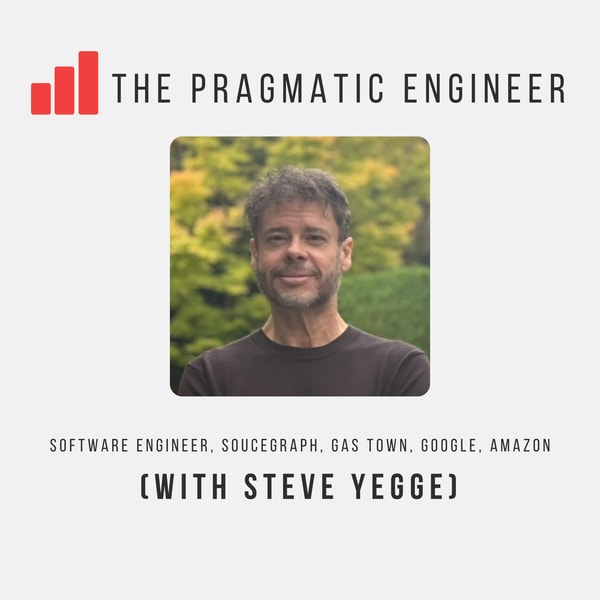
Steve Yegge [https://steve-yegge.blogspot.com/] has spent decades writing
software and thinking about how the craft evolves. From his early years at
Amazon and Google, to his influential blog posts, he has often been early at
spotting shifts in how software gets built.
In this episode of Pragmatic Engineer, I talk with Steve about how AI is
changing engineering work, why he believes coding by hand may gradually
disappear, and what developers should focus on, instead. We discuss his latest
book, Vibe Coding [https://itrevolution.com/product/vibe-coding-book/], and the
open-source AI agent orchestrator he built called Gas Town,
[https://github.com/steveyegge/gastown] which he said most devs should avoid
using.
Steve shares his framework for levels of AI adoption by engineers, ranging from
avoiding AI tools entirely, to running multiple agents in parallel. We discuss
why he believes the knowledge that engineers need to know keeps changing, and
why understanding how systems evolve may matter more than mastering any
particular tool.
We also explore broader implications. Steve argues that AI’s role is not
primarily to replace engineers, but to amplify them. At the same time, he warns
that the pace of change will create new kinds of technical debt, new
productivity pressures, and fresh challenges for how teams operate.
—
Timestamps
(00:00) Intro
(01:43) Steve’s latest projects
(02:27) Important blog posts
(04:48) Shifts in what engineers need to know
(10:46) Steve’s current AI stance
(13:23) Steve’s book Vibe Coding
(18:25) Layoffs and disruption in tech
(31:13) Gas Town
(40:10) New ways of working
(51:08) The problem of too many people
(54:45) Why AI results lag in business
(59:57) Gamification and product stickiness
(1:04:54) The ‘Bitter Lesson’ explained
(1:07:14) The future of software development
(1:23:06) Where languages stand
(1:24:47) Adapting to change
(1:27:32) Steve’s predictions
—
The Pragmatic Engineer deepdives relevant for this episode:
• Vibe coding as a software engineer
[https://newsletter.pragmaticengineer.com/p/vibe-coding-as-a-software-engineer]
• The full circle of developer productivity with Steve Yegge
[https://newsletter.pragmaticengineer.com/p/steve-yegge]
• AI Tooling for Software Engineers in 2026
[https://newsletter.pragmaticengineer.com/p/ai-tooling-2026]
• The AI Engineering Stack
[https://newsletter.pragmaticengineer.com/p/the-ai-engineering-stack]
—
Production and marketing by
[https://penname.co/]https://penname.co/
[https://newsletter.pragmaticengineer.com/p/engineers-leading-projects]. For
inquiries about sponsoring the podcast, email podcast@pragmaticengineer.com.
Get full access to The Pragmatic Engineer at
newsletter.pragmaticengineer.com/subscribe
[https://newsletter.pragmaticengineer.com/subscribe?utm_medium=podcast&utm_campaign=CTA_4]
Highlights
Highlights
Chapters
Chapters
Transcript
Transcript
