scripod.com

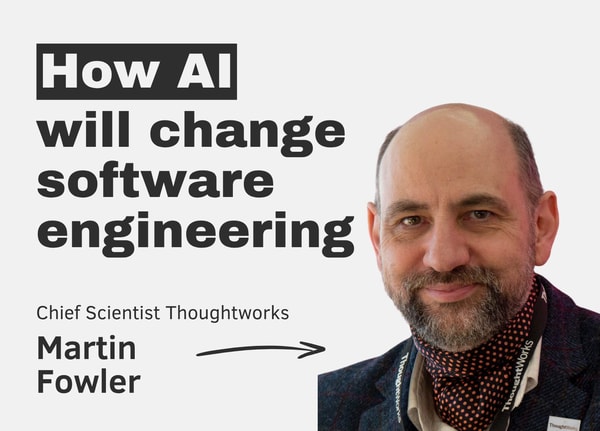
How AI will change software engineering – with Martin Fowler
The Pragmatic Engineer

Shownote

Brought to You By: •⁠ Statsig [http://statsig.com/pragmatic] ⁠ — ⁠ The unified platform for flags, analytics, experiments, and more. AI-accelerated development isn’t just about shipping faster: it’s about measuring whether, what you ship, actually delivers value. This is where modern experimentation with Statsig comes in. Check it out. [http://statsig.com/pragmatic] •⁠ Linear [https://linear.app/pragmatic?utm_source=gergely&utm_medium=newsletter&utm_campaign=pragmatic-engineer] ⁠ — ⁠ The system for modern product development. I had a jaw-dropping experience when I dropped in for the weekly “Quality Wednesdays” meeting at Linear. Every week, every dev fixes at least one quality isse, large or small. Even if it’s one pixel misalignment, like this one [https://x.com/GergelyOrosz/status/1970855759639425349?s=20]. I’ve yet to see a team obsess this much about quality. Read more about how Linear does Quality Wednesdays [https://linear.app/now/quality-wednesdays?utm_source=gergely&utm_medium=newsletter&utm_campaign=pragmatic-engineer] – it’s fascinating! — Martin Fowler is one of the most influential people within software architecture, and the broader tech industry. He is the Chief Scientist at Thoughtworks and the author of Refactoring [https://www.amazon.com/Refactoring-Improving-Existing-Addison-Wesley-Signature/dp/0134757599] and Patterns of Enterprise Application Architecture [https://www.amazon.com/Patterns-Enterprise-Application-Architecture-Martin/dp/0321127420], and several other books. He has spent decades shaping how engineers think about design, architecture, and process, and regularly publishes on his blog, MartinFowler.com [http://MartinFowler.com]. In this episode, we discuss how AI is changing software development: the shift from deterministic to non-deterministic coding; where generative models help with legacy code; and the narrow but useful cases for vibe coding. Martin explains why LLM output must be tested rigorously, why refactoring is more important than ever, and how combining AI tools with deterministic techniques may be what engineering teams need. We also revisit the origins of the Agile Manifesto and talk about why, despite rapid changes in tooling and workflows, the skills that make a great engineer remain largely unchanged. — Timestamps (00:00) Intro (01:50) How Martin got into software engineering  (07:48) Joining Thoughtworks  (10:07) The Thoughtworks Technology Radar (16:45) From Assembly to high-level languages (25:08) Non-determinism  (33:38) Vibe coding (39:22) StackOverflow vs. coding with AI (43:25) Importance of testing with LLMs  (50:45) LLMs for enterprise software (56:38) Why Martin wrote Refactoring  (1:02:15) Why refactoring is so relevant today (1:06:10) Using LLMs with deterministic tools (1:07:36) Patterns of Enterprise Application Architecture (1:18:26) The Agile Manifesto  (1:28:35) How Martin learns about AI  (1:34:58) Advice for junior engineers  (1:37:44) The state of the tech industry today (1:42:40) Rapid fire round — The Pragmatic Engineer deepdives relevant for this episode: • Vibe coding as a software engineer [https://newsletter.pragmaticengineer.com/p/vibe-coding-as-a-software-engineer] • The AI Engineering stack [https://newsletter.pragmaticengineer.com/p/the-ai-engineering-stack] • AI Engineering in the real world [https://newsletter.pragmaticengineer.com/p/ai-engineering-in-the-real-world] • What changed in 50 years of computing [https://newsletter.pragmaticengineer.com/p/what-changed-in-50-years-of-computing?utm_source=publication-search] — Production and marketing by ⁠⁠⁠⁠⁠⁠⁠⁠ [https://penname.co/]https://penname.co/⁠⁠⁠⁠⁠⁠⁠⁠ [https://newsletter.pragmaticengineer.com/p/engineers-leading-projects]. For inquiries about sponsoring the podcast, email podcast@pragmaticengineer.com. Get full access to The Pragmatic Engineer at newsletter.pragmaticengineer.com/subscribe [https://newsletter.pragmaticengineer.com/subscribe?utm_medium=podcast&utm_campaign=CTA_4]

Highlights

Martin Fowler, a seminal figure in software engineering, reflects on how the industry is navigating the transformative impact of AI. From foundational practices like refactoring to modern workflows such as vibe coding, he offers a seasoned perspective on what’s changing—and what remains constant—in the craft of building software.
04:45
Object-oriented thinking was a radical concept in the mid-1980s.
12:46
The radar’s public release stems from ThoughtWorks’ ethos of sharing all internal work openly.
22:21
Describing tasks in structured notation improves LLM understanding over plain English.
30:38
LLMs are inefficient at simple refactoring tasks compared to tools like Resharper
33:38
Vibe Coding removes the learning loop crucial for evolving code.
39:22
Developers should never blindly trust code from LLMs—they must understand, test, and refactor it.
49:00
LLMs blur the line between thinking and coding by turning natural language into executable logic
53:37
LLMs are good at refactoring code
56:40
Fowler decided to write 'Refactoring' because Kent Beck was focused on Extreme Programming
1:02:15
With AI generating more code, refactoring will become increasingly important.
1:27:07
Boris built 20 interactive prototypes in two days using AI-assisted prompts.
1:35:01
Probe AI's advice to understand its sources and limitations
1:40:22
AI won't wipe out software development but will change it

Chapters

Intro
00:00
How Martin got into software engineering 
01:50
Joining Thoughtworks 
07:48
The Thoughtworks Technology Radar
10:07
From Assembly to high-level languages
16:45
Non-determinism 
25:08
Vibe coding
33:38
StackOverflow vs. coding with AI
39:22
Importance of testing with LLMs 
43:25
LLMs for enterprise software
50:45
Why Martin wrote Refactoring 
56:38
Why refactoring is so relevant today
1:02:15
Using LLMs with deterministic tools
1:06:10
Patterns of Enterprise Application Architecture
1:07:36
The Agile Manifesto 
1:18:26
How Martin learns about AI 
1:28:35
Advice for junior engineers 
1:34:58
The state of the tech industry today
1:37:44
Rapid fire round
1:42:40

Transcript

Gergely Orosz: What similar changes have you seen that could compare to some extent to AI in the technology field? Martin Fowler: It's the biggest, I think, in my career. I think if we looked back at the history of software development as a whole, the com...
