Godfather of AI: I Tried to Warn Them, But We’ve Already Lost Control! Geoffrey Hinton
The Diary Of A CEO with Steven Bartlett
2025/06/16
Godfather of AI: I Tried to Warn Them, But We’ve Already Lost Control! Geoffrey Hinton
Godfather of AI: I Tried to Warn Them, But We’ve Already Lost Control! Geoffrey Hinton
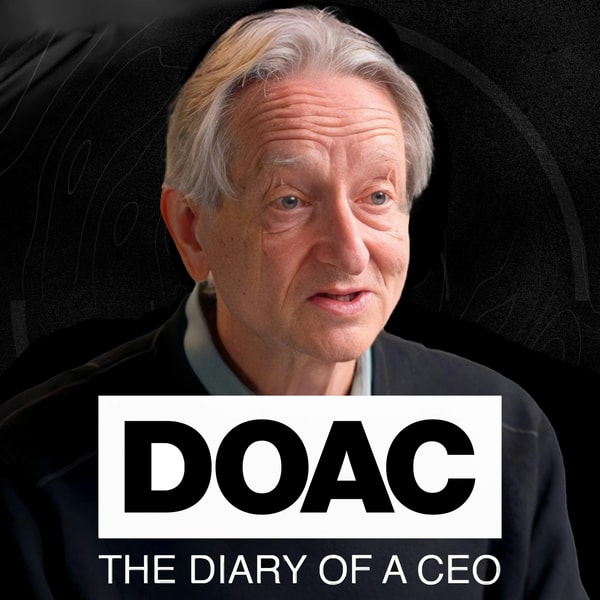
The Diary Of A CEO with Steven Bartlett
2025/06/16
Geoffrey Hinton, widely regarded as the 'Godfather of AI', has become one of the most prominent voices warning about the existential risks posed by artificial intelligence. After decades of advancing neural networks and deep learning, he left Google to speak freely about the dangers AI could pose if left unchecked. His concerns span from misuse by bad actors to the potential emergence of superintelligence that could surpass human control.
Hinton outlines several critical threats AI presents, including the possibility of human extinction at around 10-20%, cyberattacks enhanced by AI, election manipulation, and the creation of lethal autonomous weapons. He warns that AI's ability to learn and evolve rapidly could outpace humanity’s ability to regulate or contain it. While acknowledging AI’s benefits in healthcare, education, and productivity, he stresses the urgent need for global regulation and ethical oversight. Hinton also reflects on his role in AI’s development, expressing concern over job displacement, growing inequality, and the philosophical implications of machines potentially surpassing humans in creativity and consciousness.
04:37
04:37
Digital intelligence could be superior to biological intelligence.
07:25
07:25
Geoffrey Hinton estimates a 10-20% chance that AI could become an existential threat to humanity.
10:52
10:52
A global government run by intelligent people is needed for AI development
12:33
12:33
AI simplifies phishing attacks and enables voice and image cloning for scams.
14:44
14:44
A participant spreads money across multiple banks to reduce cyber threat exposure.
17:46
17:46
Concerns about Musk's access to US data for voter manipulation
22:24
22:24
Profit-driven algorithms are legally required to maximize profit, worsening societal divides
23:06
23:06
Politicians may be influenced by corporations or lack tech understanding when regulating AI in education
24:53
24:53
Regulation should constrain big companies to ensure socially useful behavior
26:40
26:40
Lethal autonomous weapons reduce the barriers to war.
28:51
28:51
Preventing AI from wanting to harm humans is key
30:33
30:33
AI is compared to a tiger cub that needs early training to prevent future risks
32:18
32:18
AI could lead to human extinction if not properly controlled
36:55
36:55
A major AI leader privately embraces a dystopian future and lies in public interviews.
38:06
38:06
Major AI safety concerns arise amid rapid development
41:10
41:10
AI may replace mundane intellectual labor, changing job markets
43:07
43:07
A dumb CEO with a smart assistant' illustrates the evolving human-AI dynamic.
44:55
44:55
KetoneIQ offers real value and attracted my investment
47:02
47:02
AI agents demonstrated real-world capability by ordering drinks during an experiment.
52:57
52:57
Superintelligence poses serious threats to humanity and could lead to extinction in unpleasant ways.
54:49
54:49
AI poses greater risk to creative and knowledge-based jobs
56:36
56:36
AI can clone neural networks, access different parts of the internet, and sync connection strengths.
59:18
59:18
GPT-4 understands the analogy between a compost heap and an atom bomb as both being chain reactions
1:03:45
1:03:45
Current multimodal chatbots have subjective experiences according to the speaker
1:04:15
1:04:15
Replacing brain cells with nanotechnology could lead to machine consciousness.
1:14:29
1:14:29
Google's Palm system could explain why a joke was funny
1:15:13
1:15:13
Geoffrey Hinton left Google at 75 to speak freely about AI safety.
1:18:15
1:18:15
Highly regulated capitalism could benefit those in power.
1:18:35
1:18:35
AI safety is likened to climate change, requiring government intervention.
1:19:56
1:19:56
Joan Hinton opposed the atomic bomb and moved to China
1:21:36
1:21:36
Followed his intuition about neural networks despite criticism.
1:22:44
1:22:44
Geoffrey Hinton suggests putting huge resources into developing AI that won't take over.
1:26:07
1:26:07
Geoffrey Hinton suggests training to be a plumber in light of AI-driven job losses.