
Neil deGrasse Tyson: The Brutal Truth About Astrology! Our Breath Contains Molecules Jesus Inhaled!
The Diary Of A CEO with Steven Bartlett
2025/10/13
Neil deGrasse Tyson: The Brutal Truth About Astrology! Our Breath Contains Molecules Jesus Inhaled!
Neil deGrasse Tyson: The Brutal Truth About Astrology! Our Breath Contains Molecules Jesus Inhaled!
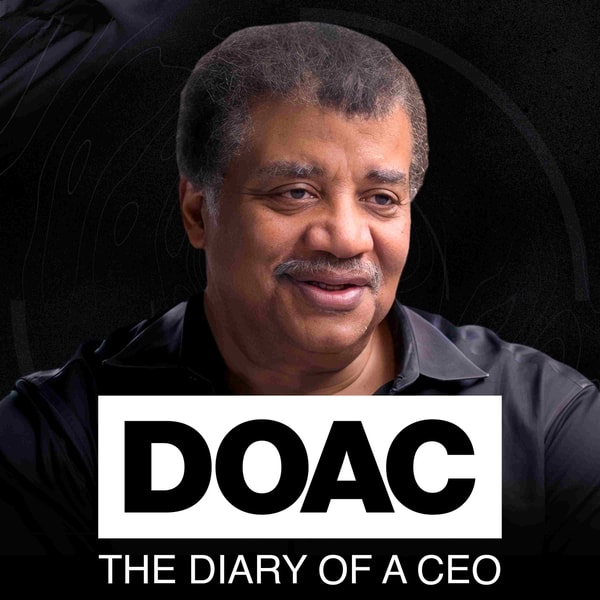
The Diary Of A CEO with Steven Bartlett
2025/10/13
In a wide-ranging and thought-provoking discussion, astrophysicist Neil deGrasse Tyson delves into the deepest questions of existence, blending science with philosophy to challenge common beliefs about life, the universe, and humanity’s place within it. From cosmic phenomena to cultural trends, he offers a compelling vision shaped by evidence, curiosity, and humility.
Neil deGrasse Tyson explores how scientific understanding reshapes our view of identity, purpose, and connection. He emphasizes that humans are made of stardust, sharing DNA across species, which underscores a fundamental unity in life. He critiques rising belief in astrology as anti-scientific, warning it undermines progress. The conversation covers free will, the simulation hypothesis, and AI's future role, suggesting superintelligence may relegate humans to a subordinate position. While interstellar travel remains unlikely due to cost and logistics, medical advances might soon extend human lifespans significantly. Tyson stresses creating personal meaning through contribution rather than seeking cosmic purpose, advocates for scientific literacy, and highlights the importance of humility in the face of uncertainty. He also reflects on loss, parenting, and the societal need for informed civic engagement to sustain scientific advancement and democratic integrity.
05:58
05:58
We are made of stardust—the universe is within us.
14:35
14:35
If an argument lasts over five minutes, both sides are likely wrong.
18:59
18:59
Academics should focus on what's true when discussing religion.
23:34
23:34
Religious rituals may be key to understanding what defines humans in the fossil record.
28:11
28:11
The greatest value of religious institutions may be the community they provide.
34:17
34:17
Only God can make a tree, highlighting the divine beauty in nature.
38:31
38:31
Frequent global disasters suggest we're in a simulation designed for complexity and engagement.
40:05
40:05
One can create meaning in life even if free will is an illusion.
43:46
43:46
Medicine may soon add more than a year of life for every year lived.
46:30
46:30
Billionaires' quest for immortality diverts resources from society's greater needs.
51:59
51:59
Superintelligence may treat humans like pets, depending on survival needs.
53:31
53:31
The moon landing was a Cold War move, not a scientific one.
1:01:30
1:01:30
A round-trip to Mars could take 3 to 5 years with current propulsion methods
1:07:07
1:07:07
A black hole can form when a high-mass star's gravity overcomes its explosion, collapsing it.
1:07:51
1:07:51
A golf-ball-sized black hole could swallow Earth
1:09:14
1:09:14
Every breath contains molecules once inhaled by all humans in history
1:10:44
1:10:44
We share air and water molecules with historical figures like Jesus and Muhammad
1:15:25
1:15:25
Just as a ship reveals new horizons, the universe may have endless horizons beyond what we observe
1:19:23
1:19:23
An unseen alien in a locked box is equivalent to no alien for scientists
1:22:56
1:22:56
There are likely about a hundred civilizations in the Milky Way Galaxy currently.
1:25:38
1:25:38
Using humans as an energy source in The Matrix violates the second law of thermodynamics.
1:30:31
1:30:31
Great scientists are defined more by the questions they ask than the answers they find.
1:36:26
1:36:26
Crystals are in the lowest energy state, so they cannot emit healing energy.
1:37:18
1:37:18
An astrologer failed to guess Neil's star sign despite multiple attempts.
1:42:15
1:42:15
Atheists are just one religion more consistent than the religious.
1:46:54
1:46:54
The best wisdom comes from learning through your own mistakes, not following others' advice.
1:54:26
1:54:26
Basic science feeds engineering and economies; cutting it can be devastating
2:03:22
2:03:22
Reading old science books shows how confident past beliefs can become embarrassing, keeping me humble.