
Do AI Models Agree On How They Encode Reality?
The Quanta Podcast
Feb 03
Do AI Models Agree On How They Encode Reality?
Do AI Models Agree On How They Encode Reality?
The Quanta Podcast
Feb 03
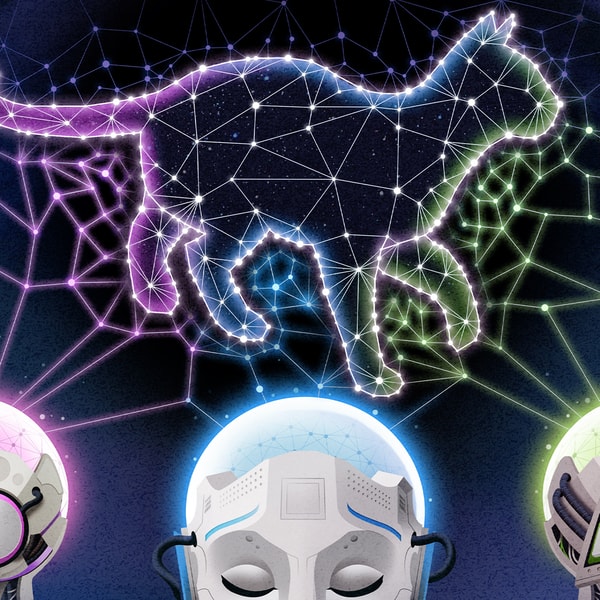
This episode dives into a profound question at the intersection of artificial intelligence and philosophy: do different AI models, trained on wildly divergent data, end up 'seeing' the world in fundamentally similar ways?
Drawing on Plato’s allegory of the cave, the podcast explores how AI models—like prisoners perceiving only shadows—construct internal representations from limited, imperfect data streams. Despite training on different modalities (text vs. images) and datasets, models increasingly converge on similar high-dimensional vector structures for concepts like 'table', suggesting they may be approximating shared, abstract truths about reality. This convergence isn’t apparent through direct vector comparisons but emerges when analyzing relational patterns—how models preserve similarity across inputs ('similarity of similarities'). Researchers use these alignment metrics not only to probe AI understanding but also to improve model interoperability and interpretability. Yet key challenges remain: the meaning behind numerical similarity scores is still philosophically and technically ambiguous, and while trends point toward platonic convergence with scale, perfect equivalence hasn’t been observed. Ultimately, the episode frames representation similarity as both a practical engineering tool and a lens into deeper questions about perception, knowledge, and what it means for any intelligence—human or artificial—to grasp reality.
03:27
03:27
Plato’s allegory of the cave is used as a starting-point to understand AI’s limited view of reality
11:24
11:24
Similarities in representations across different models suggest they capture more than just specific quirks of their input data
14:10
14:10
If different AI models trained on different data show similar representations, it's evidence they're converging on a 'platonic representation' of the world
19:28
19:28
As models get better with more data and computing power, their conceptions of objects like a table become more similar, suggesting they're getting a better understanding of reality
28:05
28:05
In Plato's cave allegory, people mistake shadows for truth
