The Safety Dividend Conundrum
The Daily AI Show
Jun 27
The Safety Dividend Conundrum
The Daily AI Show
Jun 27
Shownote
Shownote
In the near future, we will reach a point where self-driving vehicles are
undeniably safer than human drivers. It may be 5 years away or perhaps more.
Either way, the day is coming where humans are considered too dangerous to put
in charge of a vehicle.
That shift will not replace every driver at once. Specialized drivers, emergency
operators, construction haulers, rural edge cases, and unusual transport jobs
may remain human for much longer. The first major collapse will come in ordinary
personal transport: taxis, rideshare trips, airport runs, late-night pickups,
routine errands, and point-to-point city travel.
Once that happens, the public gains something real. Fewer crashes. Cheaper
rides. Better access for people who cannot drive. Less drunk driving. Less
fatigue. A transportation system that works without waiting for a person to
accept the fare.
But the money does not disappear. The wages once spread across thousands of
drivers become savings, margins, lower fares, fleet revenue, software revenue,
insurance changes, and city tax opportunities. The driver is removed from the
vehicle, but the value created by removing the driver has to go somewhere.
The Conundrum:
One side says the safety dividend should flow quickly to the public. If
driverless transport is safer and cheaper, cities should not burden it with
labor settlements, transition fees, artificial quotas, or legacy claims that
keep prices higher and access lower. Taxi and rideshare driving would be
disappearing because the function changed, the same way other jobs disappeared
when the machine no longer needed the person.
The other side says this is not ordinary churn. Human drivers carried the old
system, followed rules set by cities and platforms, absorbed risk on public
roads, and built the market that automation now replaces. If safer driverless
transport turns their work into lower fares and private profit while leaving
them with nothing, then a public safety improvement becomes a wealth transfer
away from the workers who made the service possible.
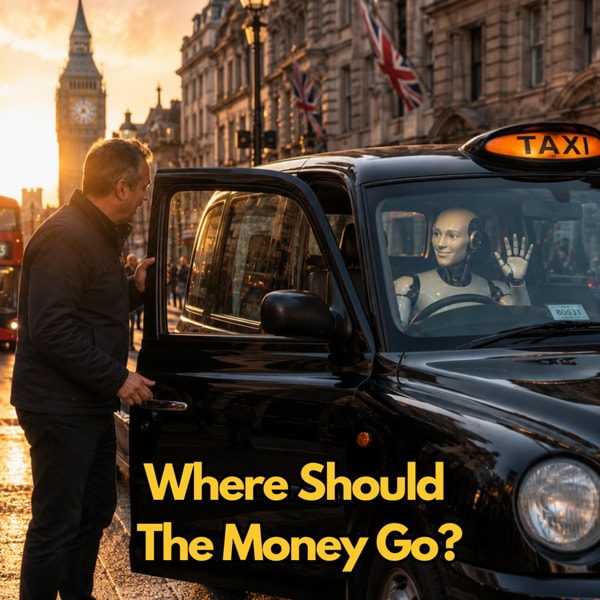
When driverless transport becomes safer than human driving, who should have the
stronger claim on the value created by removing the driver: the public that
gains cheaper and safer mobility, or the workers whose livelihoods were
displaced to create that gain?
Highlights
Highlights
This podcast explores a looming societal dilemma: as self-driving vehicles become safer than human drivers, a massive 'safety dividend' is created. The core question is not about technology, but about fairness: who has the stronger claim on the value generated by removing the human driver—the public or the displaced workers?
Chapters
Chapters
The Core Question: Who Deserves the Wealth from Safer Self-Driving Cars?
00:00The Staggering Cost of Human Error: How Much is the 'Safety Dividend' Worth?
05:44The Moral Calculus: Is It Wrong to Delay AVs to Protect Jobs?
08:38The Gig Worker's Plight: Did Drivers Build the System Only to Be Replaced?
14:16The Final Verdict: A Clash Between the Greater Good and Justice for the Displaced
22:53Transcript
Transcript
Brian: Hey, what's going on, everybody? Welcome to another Safety Dividend Conundrum. I'm Brian. And this week, we're talking about driverless taxis. Well, sort of. Really, it's a bigger conversation. But the conversation was born out of something I read a...