
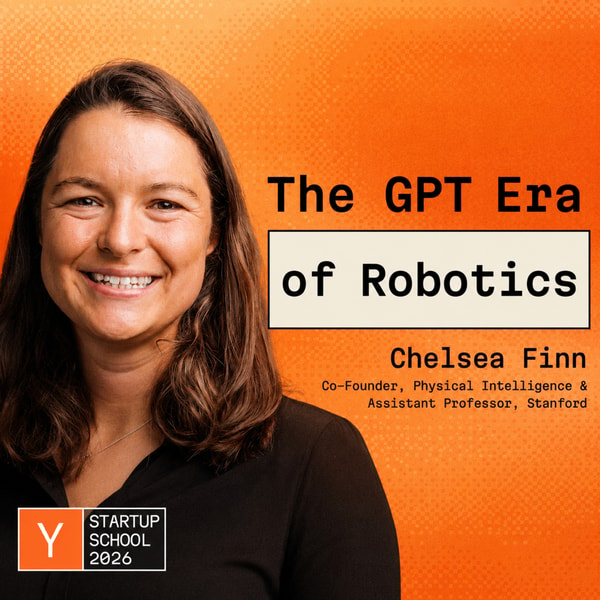
Chelsea Finn: This is the State of the Art in Robotics
Chelsea Finn: This is the State of the Art in Robotics
Chelsea Finn: This is the State of the Art in Robotics
This conversation explores the technical and practical challenges of building robots that can learn broadly, adapt to unfamiliar situations, and operate independently in the physical world.
The discussion begins with the gap between demonstrating a robotic skill once and performing it consistently over long periods. Reinforcement learning, efficient data collection, recovery from mistakes, and layered memory are helping improve reliability, task complexity, and operating speed.
It then turns to models trained on a mixture of robot demonstrations, human videos, and web data. By using detailed prompts and varied examples, these systems can coordinate subtasks and transfer skills across unfamiliar appliances, environments, and robot platforms without task-specific retraining. Imperfect but diverse data can even improve generalization.
The broader field is moving toward general-purpose robotic intelligence, though physical deployment remains harder than software progress. The main bottleneck is collecting enough real-world experience, while hardware expenses limit access to large embodied datasets. Finally, the conversation emphasizes that robots must become faster, safer, and more dependable. Reinforcement learning is beginning to improve on teleoperation, and newcomers can contribute through hands-on engineering, experimentation, open-source work, and collaboration.
06:58
06:58
Robots must learn from failure to become reliable.
34:57
34:57
General-purpose robots can generalize without post-training.
46:57
46:57
Embodied data may limit robotics democratization
53:04
53:04
Robots must become faster before they become ubiquitous.
