
Cloudflare's Disruption
Stratechery
2021/09/30
Cloudflare's Disruption
Cloudflare's Disruption
Stratechery
2021/09/30
This episode explores Cloudflare’s strategic move into cloud object storage with the launch of R2, analyzing how it challenges AWS S3’s dominance—not through feature parity, but via a fundamentally different economic and architectural model rooted in modularity and disruption theory.
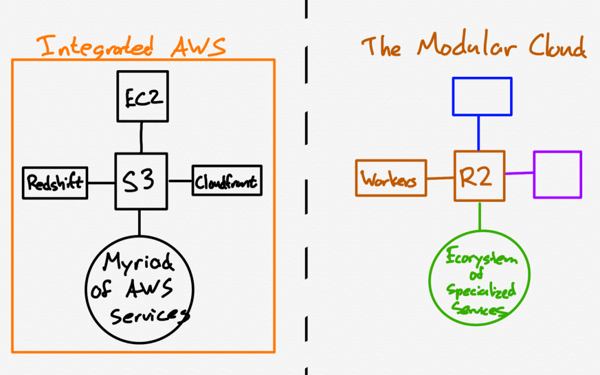
Cloudflare’s R2 is positioned as a disruptive alternative to Amazon S3, eliminating costly data egress fees and leveraging Cloudflare’s global edge network for lower latency and built-in DDoS protection—all while maintaining full S3 API compatibility. Unlike AWS’s integrated, vertically scaled cloud, Cloudflare pursues a modular strategy: building tightly coupled, purpose-built infrastructure primitives (like Workers and R2) that interoperate seamlessly but avoid replicating AWS’s broad, monolithic service catalog. This approach targets overlooked or non-consuming customers—especially developers and startups burdened by egress lock-in—and exemplifies Clay Christensen’s ‘new market disruption.’ R2’s pricing model exploits Cloudflare’s low marginal bandwidth costs, directly undermining S3’s high-margin egress revenue. The episode also traces Cloudflare’s evolution from CDN innovator to emerging fourth cloud provider, highlighting how its developer-first ethos, early focus on the long-tail web, and commitment to zero-trust and real-time tooling laid the groundwork for this expansion. Ultimately, R2 isn’t just a storage product—it’s a catalyst for a more modular, interoperable, and less vendor-locked cloud ecosystem.
00:08
00:08
R2 has no data egress fees
01:20
01:20
Cloudflare launched at TechCrunch Disrupt 2010 with a focus on enabling developers in a fragmented internet
01:54
01:54
Incumbents didn't respond to Cloudflare's offering for the long-tail of websites as it served a new market
02:42
02:42
New market disruptors compete with non-consumption by being more affordable and easier to use
03:25
03:25
New market disruptions start competing against non-consumption and later pull customers from the original to the new value network, starting with the least demanding tier
04:03
04:03
New market disruptions compete against non-consumption
04:17
04:17
AWS built compute capacity upfront and rented it on demand
06:37
06:37
AWS is profitable despite price cuts
08:48
08:48
S3 is Amazon's original web service launched on March 14, 2006
08:56
08:56
There's a notable cost difference between moving data in and out of AWS, referred to as 'AWS's Hotel California'
10:37
10:37
There's no innocent reason for AWS's egress pricing—it's designed to lock customers in
12:47
12:47
R2 eliminates egress fees and reduces latency via Cloudflare's global network
12:56
12:56
Cloudflare R2 eliminates egress fees by using its global network with low marginal bandwidth costs
15:05
15:05
Cloudflare, a minnow compared to AWS in revenue, aims to be the fourth major public cloud according to Prince.
15:24
15:24
R2 doesn't mean Cloudflare's other cloud ambitions must be the same as AWS
16:40
16:40
R2's rejection of data lock-in could create a new modular cloud service ecosystem competing with big players like Amazon
