This solo builder runs 24/7 local AI on his own hardware | Alex Finn
How I AI
Jul 13
This solo builder runs 24/7 local AI on his own hardware | Alex Finn
This solo builder runs 24/7 local AI on his own hardware | Alex Finn
How I AI
Jul 13
Unprocessed episode, you can be the first!
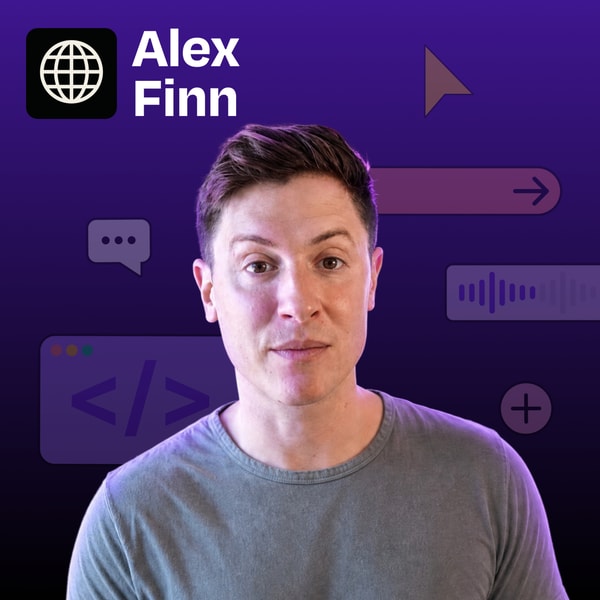
Alex Finn is an AI builder, YouTuber, and the creator of Vibe Code Academy, a community for people learning to build with AI tools. He runs one of the most ambitious local AI setups I’ve come across: three Mac Studio 512 GB machines, a DGX Spark, and a custom RTX 5090 build, all coordinated through a fleet dashboard he built himself. He’s spent five months figuring out which local models belong on which machines, how to wire them to Claude Code loops, and how to get a software factory running without babysitting it.
What you’ll learn:
- How Alex chose between a Mac Studio (512 GB unified memory), DGX Spark, and RTX 5090, and what each is actually good for
- Why Tailscale is worth installing even on a single machine, and how it lets one agent manage your entire hardware fleet
- How the build loop and review loop in Claude Code work
- How to allocate tasks by machine and model
- Why unlimited local inference changes the use-case math in a way a $20 cloud subscription never can
- What OpenClaw and Hermes are each best suited for, and why Alex runs five agents total with failover baked in
—
Brought to you by:
Runway—The creative AI platform for images, video, and more
Jira Product Discovery—Prioritize with insights, build with confidence
—
In this episode, we cover:
(00:00) Intro
(02:58) Alex's hardware stack
(03:48) What "ambient AI" means
(04:15) Alex's red-pill moment with OpenClaw
(07:04) Mac Studio vs. DGX Spark vs. RTX 5090
(13:24) How to set up local models with no technical knowledge (Tailscale + OpenClaw/Hermes)
(17:16) Fleet control dashboard: assigning 24/7 tasks across machines
(20:42) Local models as security scanners feeding Claude Code
(22:25) How Alex allocates GLM 5.2, Qwen 3.6, and Ornith 1.0 by task
(24:28) OpenClaw vs. Hermes: the honest comparison
(26:55) The software factory: build loop, review loop, rocket emoji
(31:55) Lightning round: favorite hardware, favorite model, prompting style
(34:46) Where to find Alex
—
Tools referenced:
• Claude Code: https://claude.ai/code
• OpenClaw: https://openclaw.ai/
• Hermes: https://hermes-agent.nousresearch.com/
• Tailscale: https://tailscale.com/
• Codex (OpenAI): https://openai.com/codex
• GLM 5.2 (z.ai): https://huggingface.co/zai-org/GLM-5.2
• Qwen 3.6 (Alibaba): https://huggingface.co/Qwen/Qwen3.6-35B-A3B
• Ornith 1.0: https://github.com/deepreinforce-ai/Ornith-1
• Playwright (browser testing): https://playwright.dev/
• Vercel (preview deploys): https://vercel.com/
—
Other references:
• DGX Spark (Nvidia): https://www.nvidia.com/en-us/products/workstations/dgx-spark/
• Mac Studio (Apple): https://www.apple.com/mac-studio/
• How to design AI agent loops: schedules, goals, and subagents in Claude Code and Codex: https://www.lennysnewsletter.com/p/how-to-design-ai-agent-loops-schedules
—
Where to find Alex Finn:
—
Where to find Claire Vo:
ChatPRD: https://www.chatprd.ai/
Website: https://clairevo.com/
LinkedIn: https://www.linkedin.com/in/clairevo/
—
Production and marketing by https://penname.co/. For inquiries about sponsoring the podcast, email jordan@penname.co.
