
Masterclass on Google's TPU v8 Networking
Semi Doped
Apr 24
Masterclass on Google's TPU v8 Networking
Masterclass on Google's TPU v8 Networking
Semi Doped
Apr 24
Unprocessed episode, you can be the first!
Shownote
Shownote
Google's Cloud Next 2026 keynote? Fire. 🔥
The TPU is now two chips instead of one — 8t for training, 8i for inference —
but more interestingly, it's two scale-up networking topologies too.
Austin Lyons (Chipstrat [https://www.chipstrat.com]) and Vik Sekar (Vik's
Newsletter [https://www.viksnewsletter.com/]) walk through what actually
changed, one day after the announcement. OCS? Yes. AECs? Yep. Copper? Yep.
Optics? Yep.
We cover Virgo (Google's 47 petabit/second scale-out fabric, built entirely on
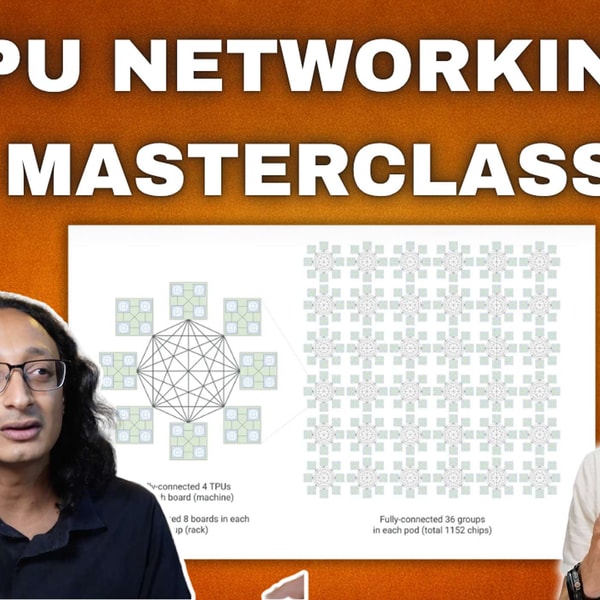
OCS), Boardfly (the new scale-up topology for MoE inference that cuts hop count
from 16 to 7), and the 3D torus Google still uses for training.
Why is optical circuit switching the substrate of Google's data center? Why do
active electrical cables still carry scale-up traffic inside racks? Why did
Google split the CPU layer too, with custom ARM Axion head nodes to keep the
TPUs fed?
Along the way we trace the Dragonfly topology lineage to a 2008 paper by John
Kim, Bill Dally, Steve Scott, and Dennis Abts. Abts went on to build Groq's
rack-scale interconnect before landing at Nvidia.
Chapters:
0:00 Intro
0:21 Two TPUs for two workloads
2:31 HBM, SRAM, and Axion CPUs
7:22 Why networking is the new bottleneck
17:14 Virgo: rebuilding scale-out on optics
25:24 3D torus Rubik's Cube scale-up for training
34:50 Boardfly: scale-up for MoE inference
42:07 Workload-specific everything
Follow Chipstrat:
Newsletter: https://www.chipstrat.com [https://www.chipstrat.com]
X: https://x.com/austinsemis [https://x.com/austinsemis]
Follow Vik:
Newsletter: https://www.viksnewsletter.com/ [https://www.viksnewsletter.com/]
X: https://x.com/vikramskr [https://x.com/vikramskr]
Highlights
Highlights
Chapters
Chapters
Transcript
Transcript
