
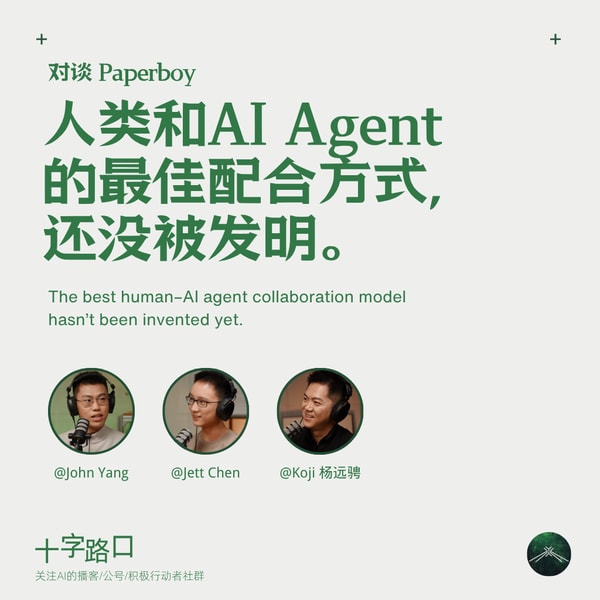
人类和 AI Agent 的最佳配合方式,还没被发明|对谈 Paperboy
十字路口Crossing
May 20
人类和 AI Agent 的最佳配合方式,还没被发明|对谈 Paperboy
人类和 AI Agent 的最佳配合方式,还没被发明|对谈 Paperboy
十字路口Crossing
May 20
This podcast episode features the Paperboy team, including 21-year-old CEO John Yang and 19-year-old founding engineer Jett Chen, who are rethinking how humans and AI agents collaborate. They argue that current session-based, prompt-driven tools like Claude Code and Manus are fundamentally flawed, and they are building a new kind of agent that learns continuously from user activity.
The core of Paperboy's approach is to move beyond the 'session-based' and 'reactive' nature of existing AI agents. Instead of requiring users to manually input context into a new window each time, Paperboy's agent learns by observing a user's computer activity, including screenshots and keystrokes, to build a persistent, personalized context. This allows the agent to be proactive, offering assistance without being prompted, and to maintain a continuous memory of the user's work. The team's interface design is inspired by WeChat's group chat model, organizing interactions as ongoing conversations rather than isolated sessions. They also discuss a 'Pace Layers' theory, suggesting that different time horizons for tasks (from seconds to hours) require different product forms, from autocomplete to IM-based agents. Internally, they have created 'Mini Vivian' and 'Auto John,' agent versions of team members that can handle tasks like recruiting. The founders have turned down acquisition offers from companies like Vercel and Cognition to pursue their vision of a more intuitive and collaborative AI interface.
00:00
00:00
Paperboy's mission is to explore the best way to collaborate with AI
01:59
01:59
The optimal human-AI collaboration method hasn't been invented yet.
06:24
06:24
Current tools lack a new dimension because they are still limited by human teams.
08:01
08:01
Paperboy solves this by having agents learn from observing user activity
14:21
14:21
Proactive agent design remains an underexplored domain
22:00
22:00
Agent predicts user intent without explicit instructions
30:19
30:19
Slack has strong network effects making it hard to replace
33:46
33:46
Different time horizons require different product forms for automation.
44:38
44:38
College provides time to build technical skills and explore.
52:21
52:21
The biggest company will come from consumer AI, not enterprise.