
Vanguard
Acquired
May 18
Vanguard
Vanguard
Acquired
May 18
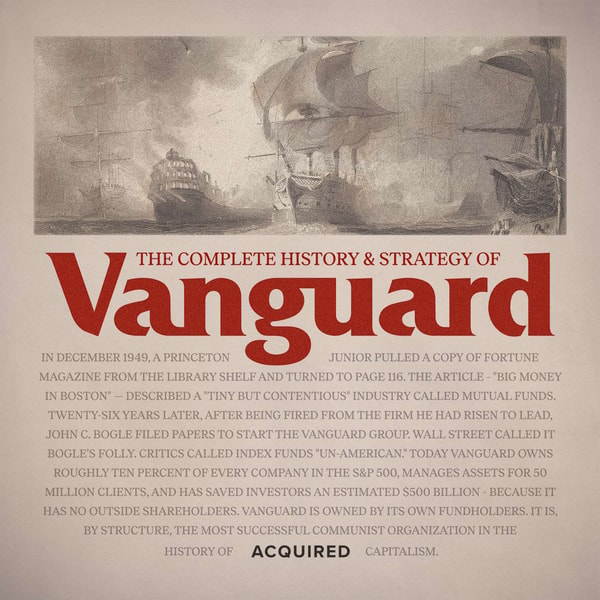
This episode explores the remarkable story of Vanguard, a financial giant that operates like a communist organization within American capitalism. Founded by Jack Bogle after he was fired, Vanguard's unique mutual ownership structure has no shareholders and returns all profits to investors through lower fees, transferring hundreds of billions from Wall Street to retail savers. The narrative traces Bogle's journey from a childhood shaped by the Great Depression to creating the first index fund for individual investors, a revolutionary idea that faced immense early struggles before transforming the entire investment industry.
Jack Bogle's Princeton thesis argued that minimizing fees is the best way to maximize returns, as all investors collectively are the market. After being fired from Wellington Management in 1974, Bogle proposed mutualizing the funds to eliminate profits, a move seen as irrational by the industry. He then created the first retail index fund in 1976, which initially struggled, raising only $11.3 million of its $150 million target. Vanguard survived by using profits from active funds to support its low-cost indexing strategy until it scaled. The 2008 financial crisis was a pivotal moment, shattering faith in active management and cementing Vanguard's role as a champion for average investors. Warren Buffett's famous bet that the Vanguard 500 Index Fund would outperform a portfolio of hedge funds over 10 years ended with the index fund winning 126% to 36%. By Bogle's death in 2019, Vanguard managed $5 trillion, yet his estate was only $80 million, contrasting sharply with the wealth of competitors. The episode concludes by analyzing Vanguard's current challenges, including competition from Fidelity and BlackRock, and the potential strategies of its first outside CEO, Salim Ramji.
00:00
00:00
it is mostly about index funds
03:48
03:48
Bogle transferred a trillion dollars to investors.
05:31
05:31
His family lost everything, his father abandoned them
25:07
25:07
Minimizing fees is the best way to maximize returns
27:20
27:20
Conservative approach ill-suited for mid-1960s market
33:47
33:47
Jerry Tsai achieved high returns through aggressive trading.
40:50
40:50
Bogle merges Wellington with Ivest to compete with Fidelity.
52:06
52:06
It was a personal conviction that went against industry norms.
1:08:59
1:08:59
The first index fund was a revolutionary move
1:32:03
1:32:03
A communist machine within capitalism
1:41:34
1:41:34
Passive investing outperforms due to low fees and behavioral advantages.
1:55:34
1:55:34
99% of Vanguard's AUM came after Bogle stepped down.
2:06:37
2:06:37
Founder's purity is essential for starting but not for scaling.
2:24:23
2:24:23
Faith in Wall Street was shattered.
2:40:28
2:40:28
Bogle left billions on the table.
2:50:45
2:50:45
Vanguard's model may now hold it back.
3:01:07
3:01:07
Vanguard's average expense ratio is 0.07%.
3:04:43
3:04:43
Wellington now manages $1.3 trillion
3:14:42
3:14:42
Ownership by fund investors aligns incentives to keep costs low.
3:30:58
3:30:58
One person can change the world.
