
The Walt Disney Company
Acquired
Jun 22
The Walt Disney Company
The Walt Disney Company
Acquired
Jun 22
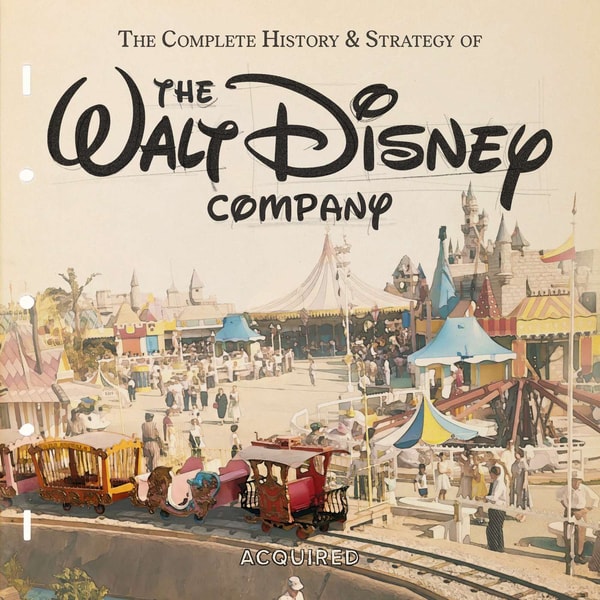
This episode explores the early history of The Walt Disney Company, from Walt Disney's childhood to his death, revealing how a relentless pursuit of ambitious, often financially risky, creative projects accidentally built one of the most powerful and enduring business models in entertainment history.
The podcast details Walt Disney's journey from a young artist in Marceline, Missouri, to the creator of an entertainment empire. It covers his early failures in Kansas City, the painful loss of Oswald the Lucky Rabbit, and the subsequent creation of Mickey Mouse. The hosts explain how the need to monetize Mickey led to the accidental invention of the 'IP flywheel'—a self-reinforcing cycle where high-quality films drive merchandise sales, which in turn fund more ambitious projects. This model was tested with the monumental gamble of 'Snow White,' which, despite its success, led to financial strain, a devastating animators' strike, and a pivot to government work during WWII. The narrative follows Walt's post-war disenchantment with animation and his obsession with model trains, which directly inspired Disneyland. The episode details the park's chaotic financing through a partnership with ABC and its construction, which transformed the company from a struggling studio into a diversified entertainment giant. It concludes with Walt's final, unrealized vision for EPCOT, his death, and the company's subsequent creative decline, setting the stage for a future turnaround.
00:00
00:00
Feature film production is a mediocre business
08:32
08:32
A paid commission for a horse drawing forged a connection between art and commerce.
14:33
14:33
Animation was a new art form enabled by film technology.
26:34
26:34
The contract marked the founding of the Disney Brothers Cartoon Studio.
35:49
35:49
The studio had no IP, no employees, and zero value.
45:11
45:11
Leverage innovation to leapfrog competitors.
54:36
54:36
Walt made Mickey Mouse and himself the brand.
1:08:13
1:08:13
Merchandise profits far exceeded film profits.
1:21:28
1:21:28
No compromise on money, talent, or time
1:36:28
1:36:28
The multi-plane camera created depth in animation.
1:58:54
1:58:54
Disney was $8 million in debt by early 1940.
2:01:47
2:01:47
The 1941 strike was the darkest moment of Walt's life.
2:17:53
2:17:53
The 'Disney Vault' strategy started with the 1944 re-release of Snow White.
2:35:30
2:35:30
Walt's model train hobby directly inspired Disneyland.
2:47:44
2:47:44
He cared about money only to reinvest it, not hoard it.
2:53:30
2:53:30
TV bypassed middlemen to reach the public directly.
3:02:26
3:02:26
The miniseries sold 10 million coonskin caps.
3:20:25
3:20:25
The parks remain the dominant profit driver.
3:26:12
3:26:12
This structure benefited shareholders despite conflicts of interest.
3:41:50
3:41:50
Walt Disney dreamed of building an entire futuristic city called EPCOT.
4:02:44
4:02:44
The core IP was rotting as American myth-making moved to creators like George Lucas and Steven Spielberg.
4:09:23
4:09:23
No other studio has replicated Disney's IP flywheel model.
4:12:27
4:12:27
Never selling the catalog enables long-term compounding
