
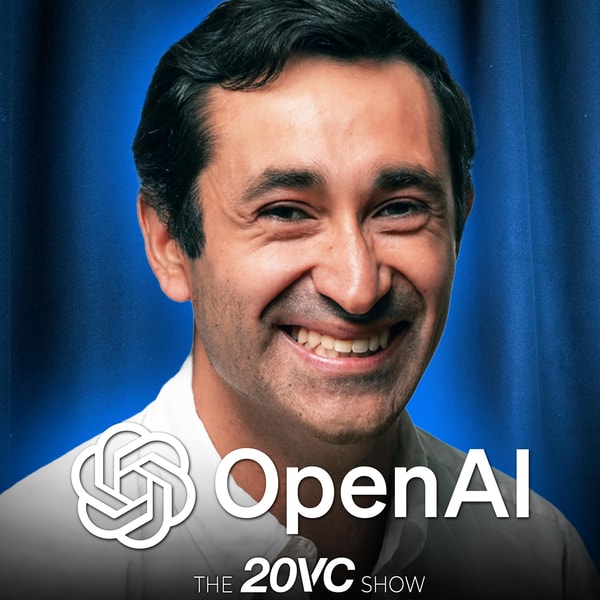
20VC: Codex vs Claude Code vs Cursor: Who Wins, Who Loses | Will All Coding Be Automated - Do We Need PMs | The Real Bottleneck to AGI | The Three Phases of Agents and What You Need to Know with Alex Embiricos, Head of Codex at OpenAI
20VC: Codex vs Claude Code vs Cursor: Who Wins, Who Loses | Will All Coding Be Automated - Do We Need PMs | The Real Bottleneck to AGI | The Three Phases of Agents and What You Need to Know with Alex Embiricos, Head of Codex at OpenAI
20VC: Codex vs Claude Code vs Cursor: Who Wins, Who Loses | Will All Coding Be Automated - Do We Need PMs | The Real Bottleneck to AGI | The Three Phases of Agents and What You Need to Know with Alex Embiricos, Head of Codex at OpenAI
Alexander Embiricos, Head of Codex at OpenAI, shares insights on the evolution and real-world impact of AI coding systems—not as replacements for engineers, but as force multipliers reshaping development workflows, product roles, and enterprise adoption.
Embiricos argues AI automation will expand, not shrink, the engineering workforce by accelerating software output and increasing demand for full-stack developers—while compressing traditional role boundaries. He identifies human effort—not technical limits—as the key bottleneck to AI adoption, stressing the need for intuitive, task-anticipating interfaces over open-ended prompting. Codex’s roadmap progresses from coding agents to general computer use and finally productized workflows, with enterprise deployment prioritizing security, safe agentic browsing, and developer empowerment over fully managed stacks. Internally, OpenAI uses AI for nearly all code generation and review, redefining IDEs around orchestration rather than editing. Codex avoids vendor lock-in via open architecture while building moats through compute, model quality, and workflow integration—not raw code data, but rich task-level knowledge. Success is measured in daily active users and deep workflow embedding, not just benchmarks. The future UI balances chat and voice with specialized graphical tools, and enduring SaaS value lies in human relationships and systems of record—not glue layers. For new engineers, AI lowers barriers to entry, rewarding public projects, agency, and taste over traditional credentials.
02:41
02:41
I'm more motivated by winning than by the fear of losing
05:14
05:14
Automation of coding tasks will increase demand for engineers in five years
07:17
07:17
A PM can step back, collaborate, and raise quality, but these tasks could be done by an eng lead or a designer
12:47
12:47
Human lack of ability or inclination to define tasks is the bottleneck
13:05
13:05
Codex app is already being used for non-coding tasks
13:52
13:52
Giving AI directly to workers helps them understand its potential and integrate it into workflows
18:00
18:00
Sales and marketing are more difficult due to increased market competitiveness
18:49
18:49
The vast majority of code is written by AI, and people rarely open IDEs
21:39
21:39
Codex automatically reviews nearly all code at OpenAI
25:56
25:56
Serving models to competitors helps them learn and supports safe AGI delivery
30:52
30:52
Daily active users is preferred over weekly active users because it signals deeper integration into daily workflows
32:05
32:05
Conversational interfaces like chat or voice will be fundamental, but power users may prefer functional graphical interfaces tailored to their needs
34:10
34:10
The best interfaces for Codex are often good for humans too, like filtering test outputs
35:44
35:44
Knowledge-work tasks are more valuable for data collection than raw code repositories
36:54
36:54
They usually enlist help from other companies for large-scale data campaigns
39:53
39:53
Aim for an un-bottlenecked agent to handle full iterative loops without human review
41:56
41:56
The evaluation of a model also has a 'vibes' factor, as people prefer to work with models they like
42:43
42:43
Having one central AI agent will make it the center of work, and people will be more likely to adopt automation
50:05
50:05
To get a job, one should be optimistic about their abilities, build high-quality projects, demonstrate agency and taste, and share these projects
55:50
55:50
Ending unlimited usage of Codex cloud caused significant user blowback
