
Your Brain is Running a Simulation Right Now [Max Bennett]
Machine Learning Street Talk (MLST)
2025/12/30
Your Brain is Running a Simulation Right Now [Max Bennett]
Your Brain is Running a Simulation Right Now [Max Bennett]
Machine Learning Street Talk (MLST)
2025/12/30
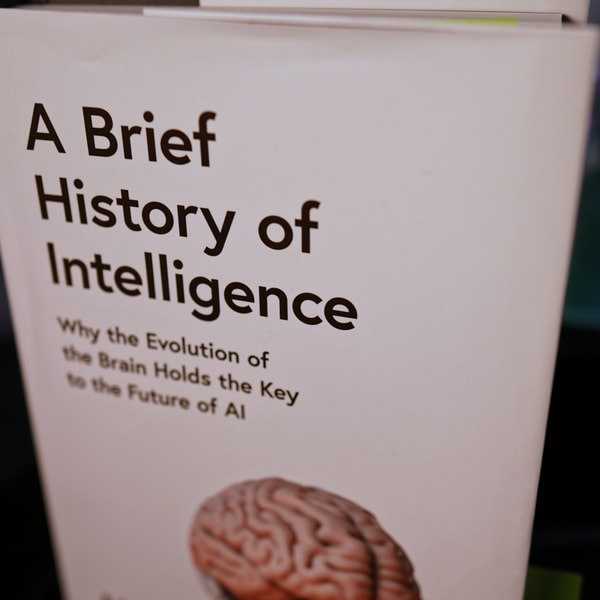
In this wide-ranging conversation, Tim and Max Bennett—a tech entrepreneur turned interdisciplinary thinker—explore intelligence not as a static trait but as an evolving, embodied, and socially embedded process shaped by deep time.
The podcast traces how brains evolved over 600 million years to become predictive, generative modeling systems—not passive receivers of reality. Perception is revealed as active inference: the brain constructs simulations, fills in gaps, and resolves ambiguity by selecting among competing internal models, explaining illusions and cognitive limits like single-threaded mental simulation. Evidence from rodents, primates, and humans shows that planning, regret, deception, and theory of mind emerge from layered neural architectures—especially the neocortex’s shift from sensory matching to intent-driven world-building. Social complexity, not just brain size, drove human cognition, with language acting as the pivotal cultural technology enabling recursive thought, shared fictions, and intergenerational knowledge transfer. Contrasting biological intelligence with AI, the discussion highlights critical differences: humans learn through embodied agency and real-world hypothesis testing, while current LMs lack world models, self-modeling, or truth-tracking mechanisms. The episode ultimately urges humility about AI capabilities—and intentionality about how we integrate tools without eroding our capacity for active understanding.
11:09
11:09
The brain simulates only one thing at a time—suggesting we're living in a simulation
11:45
11:45
What we consciously perceive is an inference based on sensory input, not the input itself
34:42
34:42
In active inference, agency emerges from building a self-model and fulfilling predictions—not optimizing a reward function
45:12
45:12
Uncertainty is measured by comparing predictions across multiple parallel self-models in the frontal cortex
51:35
51:35
Layer four atrophy in agranular PFC reflects shift from world-modeling to behavior-driven intent
1:18:57
1:18:57
Chimpanzees infer whether an experimenter can see them based on goggles, demonstrating theory of mind
1:26:22
1:26:22
Social status is a zero-sum game, unlike physical resources.
1:44:10
1:44:10
Patients with granular prefrontal damage fail the Sally-Ann test and cannot project themselves into imagined scenarios
2:00:09
2:00:09
Language enables high-bandwidth transfer of mental simulations — a unique human superpower
2:00:48
2:00:48
Memes exploit the brain's preference for surprise, similar to casinos, because humans are poor at handling low-probability, high-magnitude events.
2:37:38
2:37:38
Relying on AI for lecture transcription and note-taking is 'understanding procrastination' that may produce a society of non-thinking automatons
3:00:45
3:00:45
True AGI agents must be able to test hypotheses and reject false information, unlike static language models
