scripod.com

Building Claude Code with Boris Cherny
Shownote

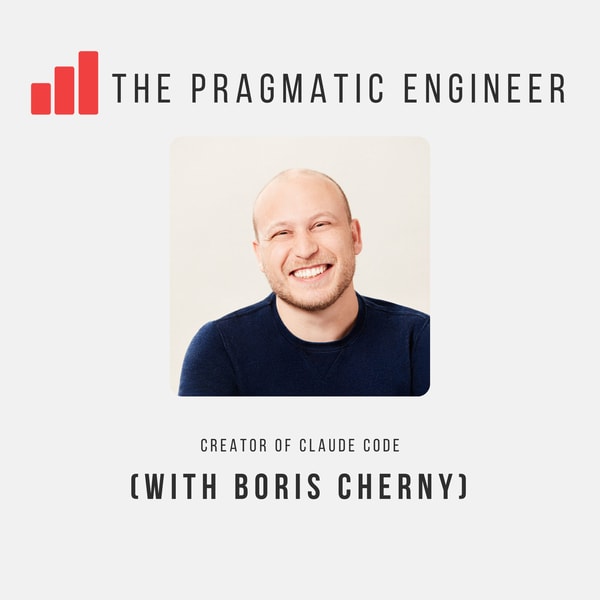
Brought to You By: • Statsig [http://statsig.com/pragmatic] — ⁠ The unified platform for flags, analytics, experiments, and more. • Sonar [https://www.sonarsource.com/pragmatic/?utm_medium=paid&utm_source=pragmaticengineer&utm_campaign=ss-ai&utm_content=podcast-sonar-ai-lp&utm_term=ww-all-x&s_category=Paid&s_source=Paid%20Other&s_origin=pragmaticengineer] – The makers of SonarQube, the industry standard for automated code review • WorkOS [https://workos.com/] – Everything you need to make your app enterprise ready. — Boris Cherny is the creator and Head of Claude Code at Anthropic. He previously spent five years at Meta as a Principal Engineer and is the author of the book Programming TypeScript [https://www.amazon.com/Programming-TypeScript-Making-JavaScript-Applications/dp/1492037656]. In this episode of Pragmatic Engineer, we went through how Claude Code was built and what it means when engineers no longer write most of the code themselves. We discuss how Claude Code evolved from a side project into a core internal tool at Anthropic and how Boris uses it day-to-day. We go deep into workflow details, including parallel agents, PR structure, deterministic review patterns, and how the system retrieves context from large codebases. We also get into how Claude Cowork was built. As coding becomes more accessible, the role of engineers shifts rather than shrinks. We examine what that shift means in practice, which skills become more important, and why the lines between product, engineering, and design are blurring. — Timestamps (00:00) Intro (11:15) Lessons from Meta (19:46) Joining Anthropic (23:08) The origins of Claude Code (32:55) Boris's Claude Code workflow (36:27) Parallel agents (40:25) Code reviews (47:18) Claude Code's architecture (52:38) Permissions and sandboxing (55:05) Engineering culture at Anthropic (1:05:15) Claude Cowork (1:12:48) Observability and privacy (1:14:45) Agent swarms (1:21:16) LLMs and the printing press analogy (1:30:16) Standout engineer archetypes (1:32:12) What skills still matter for engineers (1:35:24) Book recommendations — The Pragmatic Engineer deepdives relevant for this episode: • How Claude Code is built [https://newsletter.pragmaticengineer.com/p/how-claude-code-is-built] • How Anthropic built Artifacts [https://newsletter.pragmaticengineer.com/p/how-anthropic-built-artifacts] • How Codex is built [https://newsletter.pragmaticengineer.com/p/how-codex-is-built] • Real-world engineering challenges: building Cursor [https://newsletter.pragmaticengineer.com/p/cursor] — Production and marketing by ⁠⁠⁠⁠⁠⁠⁠⁠ [https://penname.co/]https://penname.co/⁠⁠⁠⁠⁠⁠⁠⁠ [https://newsletter.pragmaticengineer.com/p/engineers-leading-projects]. For inquiries about sponsoring the podcast, email podcast@pragmaticengineer.com. Get full access to The Pragmatic Engineer at newsletter.pragmaticengineer.com/subscribe [https://newsletter.pragmaticengineer.com/subscribe?utm_medium=podcast&utm_campaign=CTA_4]

Highlights

In this episode, Boris Cherny—creator of Claude Code and former Principal Engineer at Meta—shares firsthand insights into how AI is fundamentally transforming software engineering workflows, team structures, and the very definition of engineering excellence.
00:00
His first hand-written PR at Anthropic was rejected
16:03
Code quality significantly impacts engineering productivity through causal analysis
22:09
They wanted to understand the public Anthropic API as they had never used it before
27:44
Claude Code writes about 80% of the code at Anthropic on average
35:04
Learn mode is recommended for new members of the Claude Code team and Anthropic
36:29
Using '/config' in Claude Code to pick output styles, suggesting 'explanatory' for new code bases
40:27
Claude Code catches about 80% of bugs in CI before human review
49:53
Agentic Search—a fancy term for glob and grep—outperformed RAG for code search
52:40
Everyone at Anthropic is a 'Member of Technical Staff' to reflect generalist roles across coding, design, and user research
1:04:25
Claude Cowork was built in 10 days to serve non-engineers who were already using Claude Code for creative real-world tasks like monitoring tomato plants
1:05:18
Claude Cowork was built in about 10 days with Claude Code, adding guardrails like a virtual machine for safety
1:12:48
Claude Cowork has been an instant hit, unlike Claude Code which had a slow start
1:14:47
Uncorrelated context windows allow sub-agents to operate with fresh context, yielding better results than expanding the main agent's context
1:26:11
Just as kings employed scribes and business owners hire software engineers, the current technological shift may reduce the need for middle-men
1:30:17
Safety has become the most important concern after seeing new risks in the past year
1:34:47
A book serves as a product roadmap for the next 50 years, covering AI takeoff, singularity, and group consciousness orbiting Jupiter
1:35:24
Software engineers' roles may change like medieval scribes after the printing press

Chapters

Intro
00:00
Lessons from Meta
11:15
Joining Anthropic
19:46
The origins of Claude Code
23:08
Boris's Claude Code workflow
32:55
Parallel agents
36:27
Code reviews
40:25
Claude Code's architecture
47:18
Permissions and sandboxing
52:38
Engineering culture at Anthropic
55:05
Claude Cowork
1:05:15
Observability and privacy
1:12:48
Agent swarms
1:14:45
LLMs and the printing press analogy
1:21:16
Standout engineer archetypes
1:30:16
What skills still matter for engineers
1:32:12
Book recommendations
1:35:24

Transcript

Gergely Orosz: What happens when you join one of the top AI labs in the world, and your first pull request gets rejected? Not because the code was bad, but because you wrote it by hand. This is exactly what happened to Boris Cherny when he joined Anthropic...
