
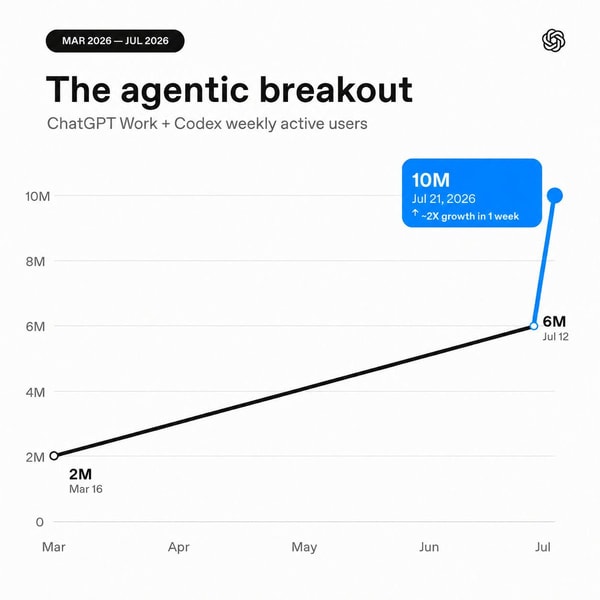
Codex from 0 to 10M Users: Building ChatGPT Work — Akshay Nathan, OpenAI
Codex from 0 to 10M Users: Building ChatGPT Work — Akshay Nathan, OpenAI
Codex from 0 to 10M Users: Building ChatGPT Work — Akshay Nathan, OpenAI
Akshay Nathan, who leads Core Product Engineering at OpenAI, discusses the launch of ChatGPT Work and the evolution of AI agents from coding tools to knowledge work platforms. He explains how the same agent harness that powers Codex now enables non-developers to accomplish complex tasks, from financial planning to performance reviews, and shares insights on product design, team dynamics, and measuring productivity in an AI-driven world.
Akshay Nathan explains that ChatGPT Work emerged from observing non-developers at OpenAI using Codex with pride, realizing agent capabilities extended beyond coding. The product shares the same underlying harness as Codex but differs in UX, hiding technical details like Git diffs while maintaining the same power. He emphasizes that the default model configuration works for most users, with advanced options like Ultra mode reserved for complex tasks. The discussion covers how Sites are replacing traditional slide decks and spreadsheets for internal collaboration, and how persistent computers, artifacts, and scheduled tasks enable personal productivity use cases like meal planning and package tracking. Akshay advises users to regularly retry tasks that models couldn't handle months ago, as capabilities improve rapidly. He warns against conflating motion with progress, suggesting teams measure success by the quality of 'at-bats'—the ability to generate ideas, build, get feedback, and validate hypotheses—rather than traditional proxies like code commits or token usage.
00:03
00:03
Bringing the power of code to everyone through prompts.
01:33
01:33
The mission of building AGI has stayed consistent
02:40
02:40
No one-size-fits-all solution.
05:28
05:28
Non-developers using Codex with pride revealed its power beyond developers.
07:19
07:19
Codex and ChatGPT Work share the same underlying harness
12:08
12:08
AI blurs job roles
19:05
19:05
Slider simplifies model selection to speed vs. quality
22:38
22:38
Users act as intermediaries, querying the AI and relaying responses
29:30
29:30
Sites are replacing decks as canonical artifacts
30:10
30:10
New model capabilities reduce the need for manual input
34:33
34:33
Show not tell principle
38:23
38:23
AI should only gather context, not write reviews
40:41
40:41
The model's improved humor and ability to make surprising connections.
47:01
47:01
Natural language queries can replace traditional UX
50:26
50:26
Balancing power and abstraction in sub-agents
57:04
57:04
Chronicle learns from computer usage to build deeper memory.
1:02:30
1:02:30
Everyone becomes T-shaped generalists with AI
1:03:20
1:03:20
Valuable ideas come from user feedback and friction
1:07:09
1:07:09
Don't conflate motion with progress.
