
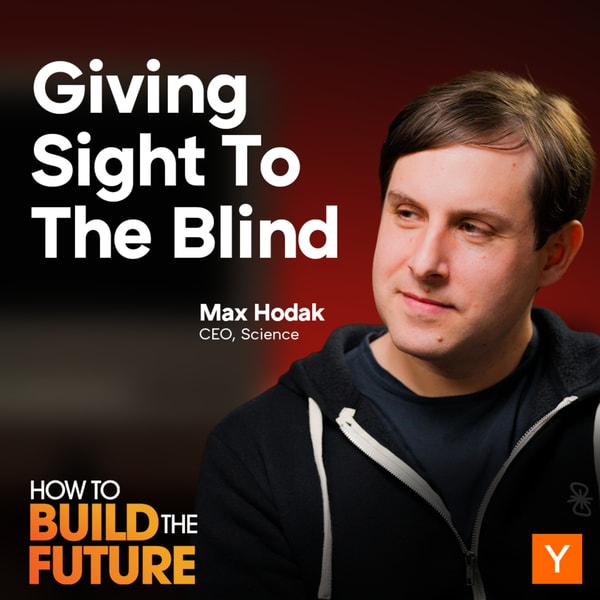
The Future Of Brain-Computer Interfaces with Science's Max Hodak
The Future Of Brain-Computer Interfaces with Science's Max Hodak
The Future Of Brain-Computer Interfaces with Science's Max Hodak
In this episode, Max Hodak—co-founder of Neuralink and founder of Science—joins the conversation to explore how brain-computer interfaces are moving beyond theory into real-world clinical impact, particularly for people who have lost their sight.
Max Hodak discusses Science’s retinal implant: a 2mm device that restores rudimentary black-and-white vision by bypassing damaged photoreceptors and leveraging neuroplasticity. While adult patients born blind face perceptual learning challenges—including distinguishing hallucinations from real input—over 40 trial participants have regained functional vision, with one reading a novel after years of blindness. The technology targets multiple causes of blindness and aims for near-native acuity, color, and field of view within 5–10 years. Science’s broader pipeline includes biohybrid neural interfaces using stem-cell-derived neurons and long-term perfusion systems reimagined from ECMO. Hodak traces his path from Transcriptic to Neuralink, emphasizing BCIs as civilization-scale tools—not incremental upgrades—and ties their acceleration to an inflection point around 2035. He expresses deep optimism: BCIs will reshape cognition, communication, and human potential in ways comparable to the early PC revolution, complementing rather than competing with AI.
09:49
09:49
Blind patients' brains generate hallucinations because they still 'want to see', even without optic nerve input.
14:47
14:47
Their clinical trial was the first to create form vision
19:42
19:42
Exciting bipolar cells with an image creates an image in the mind's eye
29:18
29:18
Biohybrid neural interfaces use engineered stem-cell-derived neurons seeded into implants to engraft onto the brain without wires or genetic modification of host tissue
49:32
49:32
The first people to live to a thousand may be alive now
52:04
52:04
BCIs will reframe the human condition by 2035