From Restoring Sight to Reimagining the Brain, with Max Hodak
From Restoring Sight to Reimagining the Brain, with Max Hodak
From Restoring Sight to Reimagining the Brain, with Max Hodak
This conversation examines how neuroscience and engineering could restore lost abilities while challenging assumptions about the brain, consciousness, and what it means to remain human.
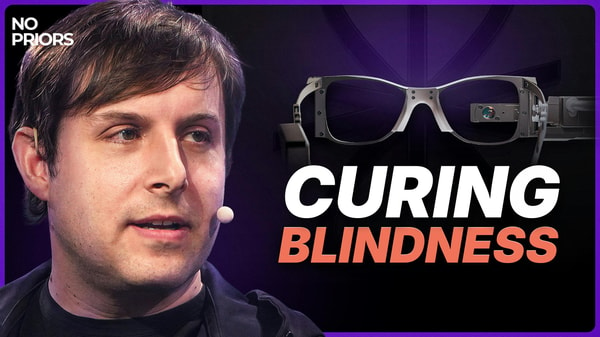
Max Hodak describes Science’s PRIMA retinal prosthesis, which uses a glasses-mounted projector to stimulate the retina and restore useful vision. Early patients have been able to complete visual tasks such as solving puzzles and reading, demonstrating that the brain can interpret signals delivered through an engineered interface. Future systems may add depth, grayscale, and color, while related approaches could address hearing, balance, movement, and other biological functions.
The discussion broadens to brain-computer interfaces, distinguishing tools that communicate with the brain from technologies integrated into neural processing itself. This raises difficult questions about mind uploading, identity, and consciousness: a copy may possess the same intelligence without preserving the original person, while continuity of experience may be more important than an unchanged identity.
Hodak argues that intelligence may arise from general computational principles rather than one particular biological substrate, making AI a valuable tool for understanding neuroscience. Science’s long-term goal is to reduce human fragility by repairing, replacing, and eventually upgrading biological systems, potentially extending healthspan, supporting adaptation to environments such as space, and enabling forms of substrate independence—while recognizing that neurodegenerative disease and the brain’s information limits remain major challenges.
00:00
00:00
Vision can be restored through neural pathways
01:03
01:03
Neuroscience can restore sight and reshape human health.
01:58
01:58
PRIMA turns projected images into functional vision
05:39
05:39
Neural devices could restore what medicine cannot
08:20
08:20
Restored vision is only the beginning.
09:03
09:03
Retinal implants can restore functional vision
14:04
14:04
Neural integration could radically transform medicine.
15:01
15:01
Identity may not survive a copied mind
16:47
16:47
Continuity may matter more than preserving identity
19:04
19:04
Intelligence may transcend its physical substrate
21:22
21:22
Restoring vision could become a major business.
23:54
23:54
The brain is the central computational system
27:02
27:02
Science aims to reduce human fragility
28:15
28:15
Biotechnology could redefine what it means to be human
29:23
29:23
BCIs may restore senses and enable substrate independence
