
The Incidental Patient Conundrum
The Daily AI Show
Jul 04
The Incidental Patient Conundrum
The Incidental Patient Conundrum
The Daily AI Show
Jul 04
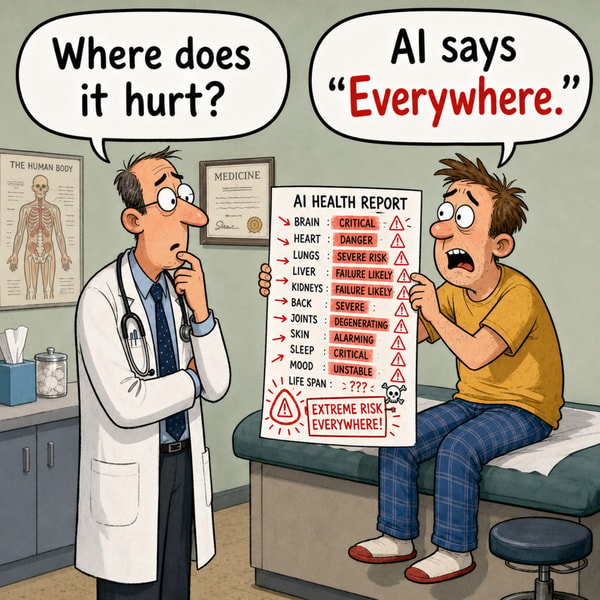
This podcast explores a profound ethical dilemma emerging from AI-assisted full-body scans: the ability to detect countless potential health risks before any symptoms appear. While this technology promises early intervention, it also creates a new class of 'pre-patients' burdened by ambiguous findings, raising the question of whether medicine should disclose everything it can see or only what can be acted upon without causing harm.
The discussion centers on the 'Incidental Patient Conundrum,' where AI's ability to create a 'living map of risk' from scans, labs, and genetics clashes with traditional symptom-based medicine. A 2024 study shows 80% of cancer deaths averted are due to early screening, not treatment, highlighting the life-saving potential. However, AI's precision also triggers 'diagnostic cascades' from incidental findings, most of which are benign, leading to overdiagnosis and unnecessary procedures. The NHS Galleri trial's failure to reduce late-stage cancer rates is attributed to lead-time bias, detecting slow-growing cancers that don't affect mortality. The permanent risk data generated by AI screening can be used by insurers, turning healthy individuals into the 'worried well' through constant monitoring. The core dilemma is that AI has removed the traditional gatekeeper of physical symptoms, forcing medicine to decide how to handle overwhelming data without destroying the concept of a healthy life.
00:01
00:01
Early detection can save lives, but also raises issues like insurance discrimination.
05:26
05:26
Disclose all risks or only actionable findings?
10:52
10:52
80% of cancer deaths averted were due to early screening.
22:16
22:16
Overdiagnosis finds harmless anomalies more often than lethal cancers
25:04
25:04
AI turns healthy people into the 'worried well'
