
🔬“We have foundation models for language, not for physics” — Anima Anandkumar, Bren Professor of Computing
Latent Space: The AI Engineer Podcast
2 DAYS AGO
🔬“We have foundation models for language, not for physics” — Anima Anandkumar, Bren Professor of Computing

Latent Space: The AI Engineer Podcast
2 DAYS AGO
Unprocessed episode, you can be the first!
Shownote
Shownote
A few years ago, Caltech Prof. and co-founder of Accelerated Understanding,
Anima Anandkumar [https://www.eas.caltech.edu/people/anima] set out to develop
the first open-source weather model with AI. Talking to experts in the field,
she was met with skepticism. Weather is chaotic, physics simulations are hard,
have been developed for decades, and require supercomputers, the data just isn’t
there. Despite reservations, Anima went forth and built. Within a year her team
had developed FourCastNet [https://arxiv.org/abs/2202.11214], a predictive model
that is competitive with the best physics-based simulations available. Thanks to
Anima, and her follow up work, anyone can now predict weather accurately over a
short timescale using consumer grade GPUs.
In the fifteen or so science episodes we’ve released on Latent.Space
[http://latent.space/], we’ve covered atoms, molecules, materials, biology, and
math. Anima is a pioneer in studying physical systems that are continuous.
Weather, fusion, and fluid or heat flow are huge areas of science that are
extremely difficult to model: they are large, chaotic, and fundamentally
multi-scale. This is a field the AI community has somewhat neglected, but one we
expect will grow fast. We plan to cover large physical systems more in coming
episodes.
One thing you can glean from Anima’s work is that this area of AI resists the
scaling ideas that have permeated the rest of the field. The data isn’t there:
open source datasets in many of these domains are limited to tens or hundreds of
thousands of examples, far from what token-hungry transformers need. Even worse,
the resolution that physics demands pushes the context length into the hundreds
of billions, so you can’t just throw more tokens at the problem. That isn’t a
ceiling though, just a slower road: progress here comes from building in
structure and inductive biases. Sorry for all you bitter-lesson-pilled language
modelers.
“If each dimension is even a few hundred grid points, which is where industrial
scale starts... we’re talking hundreds of billions to even a trillion context
length. So forget ever having a transformer for anything of this scale, all of
the world’s compute will not be enough.”
The math underneath
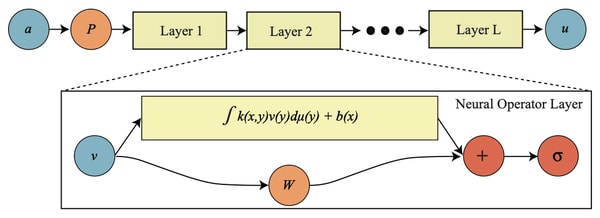
To tackle these systems, Anima pioneered a technique known as Neural Operators
[https://arxiv.org/abs/2108.08481], one of the most beautiful theoretical
developments in AI of the last decade. These allow you to combine data and
physical laws to enable multi-scale inputs and outputs. We’re no longer modeling
a grid, we’re modeling a function that evolves over many scales. This allows
Anima and crew to build in priors based upon physical intuition.
To see how physical priors are still helpful for AI modeling, let’s revisit the
problem of weather forecasting on a global scale. The earth is a sphere, which
meant that accurate modeling involved using the right basis set — the Spherical
Harmonics [https://en.wikipedia.org/wiki/Spherical_harmonics]. Run a weather
model on a grid and it blows up fast. Move to the natural basis for the problem
and it stays stable far longer, long enough to roll out months ahead instead of
days. Anima’s Fourier Neural Operator [https://arxiv.org/abs/2010.08895] learns
directly in this frequency domain, and its spherical variant powers FourCastNet
3 [https://arxiv.org/html/2507.12144v1], which models the weather across the
whole globe and keeps running stably far into the future.
The physical world is forgiving
Anima explored Neural Operators across other physical domains too, and one
striking observation is that the physical world is more forgiving than you’d
expect. In fusion, a few thousand samples are enough to predict plasma
disruptions, and to do it a million times faster than traditional simulation.
None of this is a rejection of scale, it is a different route to it. Anima
ultimately still wants to build a “foundation model for physics”, a model that
spans many phenomena and does both simulation and design. You get there by
building in the structure the physical world already has, not by waiting for
data that will never exist. It is a start, and it will take longer than the
token-driven parts of AI, because for the physical world tokens were never the
answer.
“All of the things that work with deep learning, let’s take them, but make them
a bit more principled.”
Weather is only the beginning
Neural operators and weather modeling were a personal passion of mine, so we’ve
spent much of this blog and the episode exploring this work. Anima has done so
much more! In the episode, we cover several other recent developments from
Anima:
* Anima has a series of works integrating neural networks and automated proof
techniques. We talk about TorchLean [https://arxiv.org/abs/2602.22631], a new
framework that lets you write PyTorch-style networks inside the proof assistant
Lean [https://lean-lang.org/] and formally verify them
[https://www.latent.space/p/axiom]. This is a major step for proving bounds on
neural networks, something that would be really important for someone trying to,
e.g., add a neural network as part of the control loop to their fusion reactor!
* Anima was recently appointed to the United Nations Scientific Advisory Board
[https://www.caltech.edu/about/news/anima-anandkumar-appointed-to-un-scientific-advisory-board]!
We talk with her about her goals of bringing evidence-based viewpoints to
policy, and how AI in scientific domains can improve people’s lives all over the
world.
This episode has something for every AI or science nerd! Elegant math? âś… Old
school harmonic analysis? âś… Fundamental developments in modern AI? âś… Practical
ways of modeling the physical world? âś…
Give it a watch [https://www.youtube.com/watch?v=79mIutht1f4&feature=youtu.be]!
This is a public episode. If you'd like to discuss this with other subscribers
or get access to bonus episodes, visit www.latent.space/subscribe
[https://www.latent.space/subscribe?utm_medium=podcast&utm_campaign=CTA_2]
Highlights
Highlights
Chapters
Chapters
Transcript
Transcript
